|
VOOZH | about |
|
VOOZH | about |
Prerequisite: Disk scheduling algorithms.
Given an array of disk track numbers and initial head position, our task is to find the total number of seek operations done to access all the requested tracks if First Come First Serve (FCFS) disk scheduling algorithm is used.
First Come First Serve (FCFS)
FCFS is the simplest disk scheduling algorithm. As the name suggests, this algorithm entertains requests in the order they arrive in the disk queue. The algorithm looks very fair and there is no starvation (all requests are serviced sequentially) but generally, it does not provide the fastest service.
Algorithm:
Example:
Input:
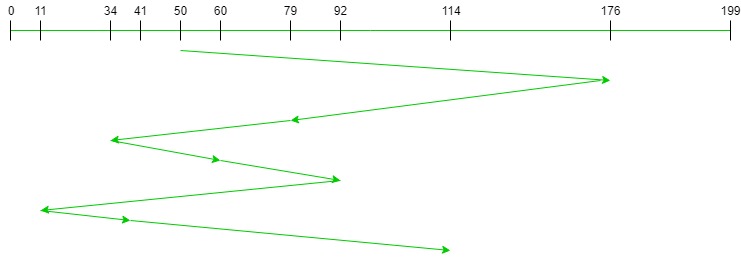
Request sequence = {176, 79, 34, 60, 92, 11, 41, 114}
Initial head position = 50

Output:
Total number of seek operations = 510
Seek Sequence is
176
79
34
60
92
11
41
114
The following chart shows the sequence in which requested tracks are serviced using FCFS.
Therefore, the total seek count is calculated as:
= (176-50)+(176-79)+(79-34)+(60-34)+(92-60)+(92-11)+(41-11)+(114-41)
= 510
Implementation:
Implementation of FCFS is given below. Note that distance is used to store absolute distance between head and current track position.
Total number of seek operations = 510
Seek Sequence is
176
79
34
60
92
11
41
114