|
VOOZH | about |
|
VOOZH | about |
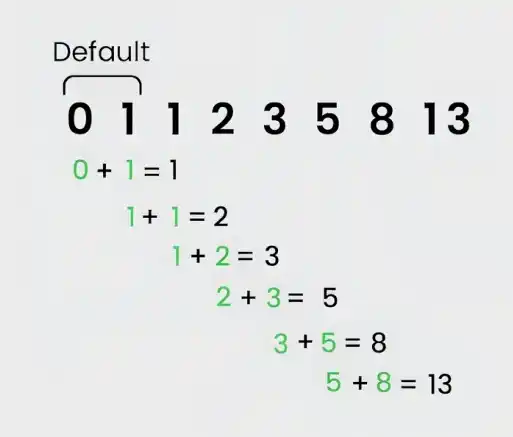
The Fibonacci Series is a sequence of numbers in which each number is the sum of the two previous numbers. The first two numbers are: 0, 1. So, the sequence becomes: 0, 1, 1, 2, 3, 5, 8, 13, 21, 34 ...
For n = 10, the Fibonacci Series is: 0 1 1 2 3 5 8 13 21 34.
Given a number n, The task is to print first n terms of the Fibonacci Series.
Examples:
Input: n = 5
Output: 0 1 1 2 3
Explanation: The Fibonacci Series starts with 0 and 1.
3rd term = 0 + 1 = 1
4th term = 1 + 1 = 2
5th term = 1 + 2 = 3
So, the series becomes: 0 1 1 2 3
Input: n = 1
Output: 0
Explanation: For n = 1, only the first Fibonacci number is printed.
The idea is to use a loop and keep track of the previous two Fibonacci numbers. Each next Fibonacci number is obtained by adding the previous two numbers.
0 1 1 2 3
Time Complexity: O(n)
Space Complexity: O(1)
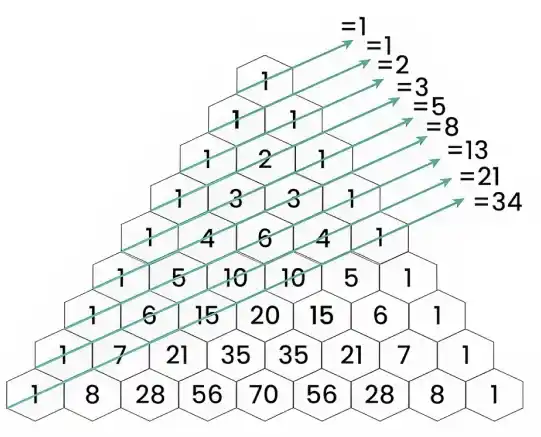
Pascal’s Triangle is a triangular arrangement of numbers where each number is the sum of the two numbers directly above it. It is widely used in combinatorics, probability, and binomial expansion. An interesting relation exists between Pascal’s Triangle and the Fibonacci Sequence. The sum of the shallow diagonals of Pascal’s Triangle forms the Fibonacci sequence.
For example:
1
1 1
1 2 1
1 3 3 1
1 4 6 4 1
Diagonal sums:
1
1
1 + 1 = 2
1 + 2 = 3
1 + 3 + 1 = 5
So, the sequence becomes: 1 1 2 3 5 ... , which is the Fibonacci sequence.
Mathematical Representation: The relation can be written as: ,
Where:
The Fibonacci sequence can be generated by adding the shallow diagonals of Pascal’s Triangle. This shows a beautiful mathematical connection between combinatorics and number sequences.
The Golden Ratio, often denoted by the Greek letter phi (Φ or ϕ), is a special mathematical constant that has been studied by mathematicians, scientists, artists, and architects for centuries.
It is an irrational number, meaning its decimal representation never ends and never repeats. Its approximate value is: ϕ ≈ 1.6180339887
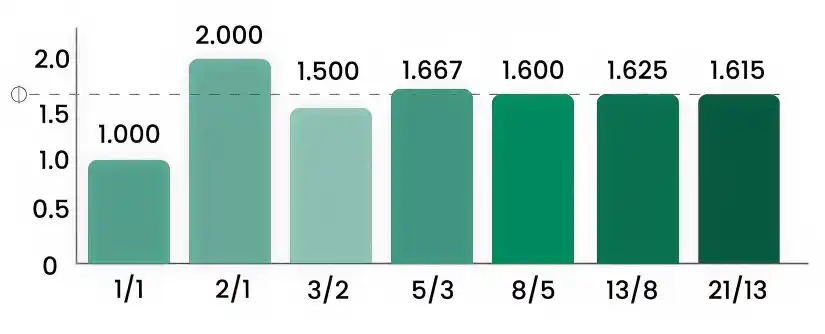
The ratio of consecutive Fibonacci numbers approaches the Golden Ratio as we move further in the Fibonacci sequence.
The following image shows how the division of consecutive Fibonacci numbers forms the Golden Ratio:
- x-axis: F(n+1)/F(n), where F(n) represents a Fibonacci number
- y-axis: Represents the value of the obtained ratio
The relationship becomes more accurate as the Fibonacci numbers grow larger.
The ratio of successive Fibonacci numbers approximates the Golden Ratio, and this relationship becomes more accurate as you move further along the Fibonacci sequence.
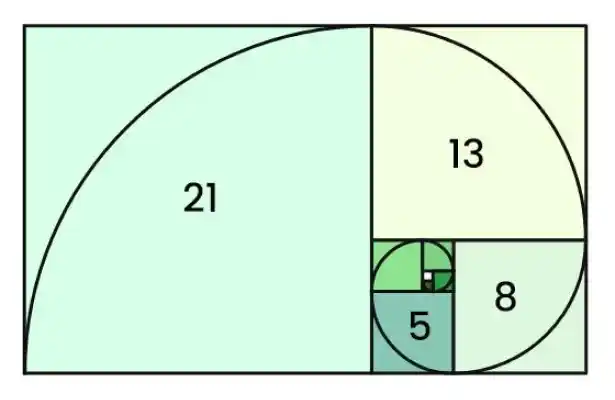
The Fibonacci Spiral is formed by drawing quarter circles inside squares whose side lengths follow the Fibonacci sequence. The side lengths of the squares are: 1, 1, 2, 3, 5, 8, 13 ...
The resulting spiral is known as the Fibonacci Spiral or Golden Spiral. It is often associated with the Golden Ratio, which is an irrational number approximately equal to 1.61803398875. The Fibonacci Spiral is considered visually pleasing and can be found in various aspects of art, architecture, and nature due to its aesthetic qualities and mathematical significance.
11/23 forms the first four Fibonacci numbers: 1, 1, 2, 3. Problems based on Fibonacci Number/Series: