FIFO is an abbreviation for first in, first out. It is a method for handling data structures where the first element is processed first and the newest element is processed last.
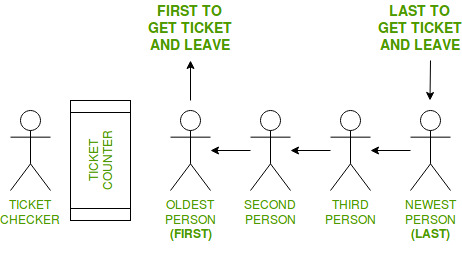
Real-life example:
👁 Image
In this example, following things are to be considered:
- There is a ticket counter where people come, take tickets and go.
- People enter a line (queue) to get to the Ticket Counter in an organized manner.
- The person to enter the queue first, will get the ticket first and leave the queue.
- The person entering the queue next will get the ticket after the person in front of him
- In this way, the person entering the queue last will the tickets last
- Therefore, the First person to enter the queue gets the ticket first and the Last person to enter the queue gets the ticket last.
This is known as First-In-First-Out approach or FIFO.
Where is FIFO used:
- Data Structures:
- Certain data structures like Queue and other variants of Queue uses FIFO approach for processing data.
- Disk scheduling:
- Disk controllers can use the FIFO as a disk scheduling algorithm to determine the order in which to service disk I/O requests.
- Communications and networking"
- Communication network bridges, switches and routers used in computer networks use FIFOs to hold data packets en route to their next destination.
Program Examples for FIFO
Program 1: Queue
OutputElements of queue-0 1 2 3 4
removed element-0
1 2 3 4
head of queue-1
Size of queue-4
Complexities Analysis:
- Time Complexity: O(N)
- Space Complexity: O(N)