|
VOOZH | about |
|
VOOZH | about |
Given a number n, find all binary sequences of length 2n such that sum of first n bits is same as sum of last n bits.
Examples:
Input:  N = 2
Output:
0101 1111 1001 0110 0000 1010

Input:  N = 3
Output:
011011 001001 011101 010001 101011 111111
110011 101101 100001 110101 001010 011110
010010 001100 000000 010100 101110 100010
110110 100100
The idea is to fix first and last bits and then recur for remaining 2*(n-1) bits. There are four possibilities when we fix first and last bits -
Below is implementation of above idea –
0101 1111 1001 0110 0000 1010
Time Complexity: O(()* N)
4^N because of 4 recursive calls, and N (simplified from 2N) for time spent printing strings of size 2N
Auxiliary Space: O(N)
There is another approach by which we generate all possible strings of length n and store them in a list at an index representing their sum. Then, we iterate through each list and generate the strings of size 2n by printing each string with all other strings in the list adding up to the same value.
0000 0101 0110 1001 1010 1111
Time complexity analysis:
generateSequencesWithSum = O((2N)*N)
permuteSequences = O((2N) * N!/(N/2)!2 * N)
let's take N = 2 as an example. Our array of possible sequence of size n would be:
| array index | 0 | 1 | 2 |
| list of strings | 00 | 01,10 | 11 |
In the list of strings which the index represents the sum, we get the count of strings of size 2n by using "n choose k" formula. I our case it would be nCk *nCk where k represents the number of 1s in each half of the string of size 2n:
k = 0, we have (2C0)^2 = 1 string (0000)
k = 1, we have (2C1)^2 string = 4 strings(0101 0110 1001 1010)
k = 2, we have (2c2)^2 = 1 string (1111)
We get our longest list of string when k = N/2, hence NCN/2 = N!/[(N/2)! * (N - N/2)!] which simplifies to NCN/2 = N!/(N/2)!2
Hence, for each element, we must iterate through, at most, NCN/2 for forming strings of length 2N
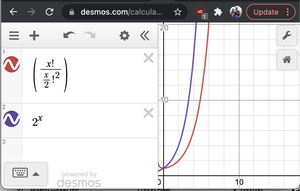
Without formal proof, if we graph 2^N and N!/(N/2)!2, we see that 2N has a faster growth rate than the latter. Therefore O(2N* N!/(N/2)2 ) < O(2N*2N) = O(22n) = O(4N)
Finally we can ignore the time complexity of generateSequencesWithSum because permuteSequence is the leading term
Time complexity: O(2N * N!/(N/2)!2 * N) (better than the first solution of O((4^N) * N, see explanation above for further details)
Auxiliary space: O(2N) because we store all binary string permutations of size N
0000 0101 0110 1001 1010 1111
Algorithm:
1. Generate all binary permutations of size n
2. Calculate sum of the bits of each permutation and remember it for second half
[for ex: for n=2, remember there are two strings with sum = 1 i.e. "01", "10" ]
3. Iterate all the generated permutations and for each of them append the second half according to the sum of the bits
Time complexity analysis:
sumOfString() = O(N) : traverse each bit and add it to sum
perm() = O(2N * N)
2N * N : we generate all permutations of binary bits of size N and find sum of the bits for each permutation
result() = O((2N) * (N!/(N/2)!)2)
2N: we iterate through all possible permutations of size N (first-Half)
NCN/2 = N!/(N/2)!2 : (second-Half maximum size) : explanation below:
let's take N = 4 as an example.:
//Hash-Map looks like
0 -> [0000] ................................(list-size: 4C0 = 1)
1 -> [0001, 0010, 0100, 1000] ................................(list-size: 4C1 = 4)
2 -> [0011, 0101, 0110, 1001, 1010, 1100] ................................(list-size: 4C2 = 6)
3 -> [0111, 1011, 1101, 1110] ................................(list-size: 4C3 = 4)
4 -> [1111] ................................(list-size: 4C4 = 1)
We observe here that each list has a size of N choose Key which will be maximum at N choose N/2
Since we are iterating all the 2N permutations and appending second half from the map. The map has the maximum sized list at N/2 position.
Worst case occurs in N/2 position where we've to traverse NCN/2 = N!/(N/2)!2 permutations.
Time complexity: O(2N * N!/(N/2)!2 )
Auxiliary space: O(2N) because we store all binary string permutations of size N