|
VOOZH | about |
|
VOOZH | about |
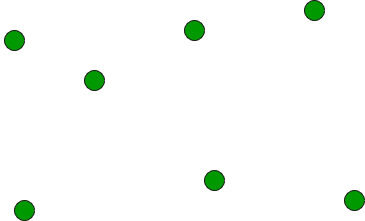
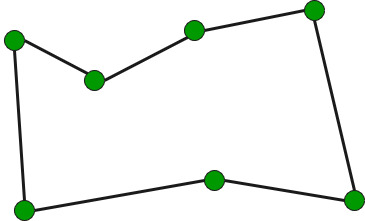
Given a set of points, connect the dots without crossing.
👁 Simple Closed Path for a given set of points 1
👁 Simple Closed Path for a given set of points 2
Example:
Input: points[] = {(0, 3), (1, 1), (2, 2), (4, 4),
 (0, 0), (1, 2), (3, 1}, {3, 3}};

Output: Connecting points in following order would
 not cause any crossing
 {(0, 0), (3, 1), (1, 1), (2, 2), (3, 3),
 (4, 4), (1, 2), (0, 3)}
We strongly recommend you to minimize your browser and try this yourself first.
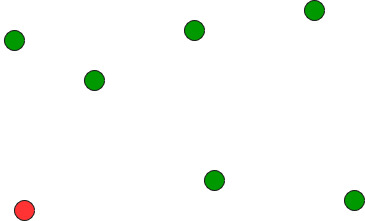
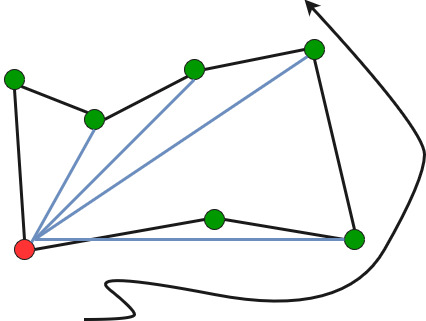
The idea is to use sorting.
👁 find the bottom-most point by comparing y coordinate of all points
How to compute angles?
One solution is to use trigonometric functions.
Observation: We don’t care about the actual values of the angles. We just want to sort by angle.
Idea: Use the orientation to compare angles without actually computing them!
Below is C++ implementation of above idea.
Output:
(0, 0), (3, 1), (1, 1), (2, 2), (3, 3),
(4, 4), (1, 2), (0, 3),
Time complexity of above solution is O(n Log n) if we use a O(nLogn) sorting algorithm for sorting points.
Auxiliary Space: O(1), since no extra space has been taken.
Source:
https://www.dcs.gla.ac.uk/~pat/52233/slides/Geometry1x1.pdf