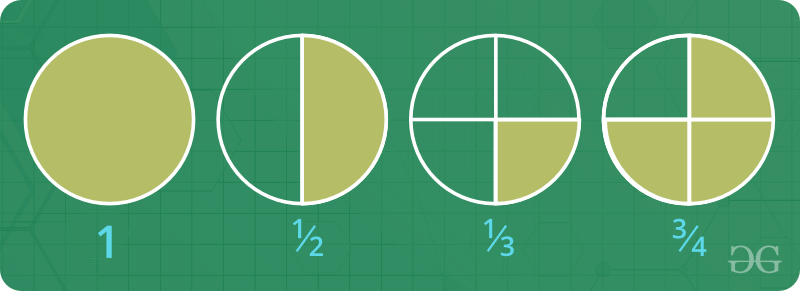
A fraction is a ratio of two values. Fractions have the form a/b where a is called the numerator, b is called the denominator and b cannot equal 0 (since division by 0 is undefined). The denominator gives how many equal parts are there. The numerator represents how many of these are taken. For example, one-half, eight-fifths, three-quarters (1/2, 8/5, 3/4).
👁 Image
Fact about Fraction :
- Fractions can be reduced if the numerator and denominator have the greatest common divisor(gcd) greater than 1.
- Addition and Subtraction of Fractions: When adding or subtracting fractions, they must have the same denominator. If they do not have the same denominator, we must find a common one for both. To do this, we first need to find the lowest common multiple(lcm) of the two denominators or multiply each fraction by the proper integers so that there will be the same denominator.
- Multiplication and Division of Fractions: When multiplying two fractions, simply multiply the two numerators and multiply the two denominators. When dividing two fractions, the first fraction must be multiplied by the reciprocal of the second fraction.
- There are three types of fractions :
- Proper Fractions: The numerator is less than the denominator. For Example, 1/3, 3/4, 2/7
- Improper Fractions: The numerator is greater than (or equal to) the denominator. For Example, 4/3, 11/4, 7/7.
- Mixed Fractions: A whole number and proper fraction together. For Example, 1 1/3, 2 1/4, 16 2/5.
How to add two fractions?
Add two fractions a/b and c/d and print the answer in the simplest form.
Examples :
Input: 1/2 + 3/2
Output: 2/1
Input: 1/3 + 3/9
Output: 2/3
Input: 1/5 + 3/15
Output: 2/5
Algorithm to add two fractions
- Find a common denominator by finding the LCM (The Least Common Multiple) of the two denominators.
- Change the fractions to have the same denominator and add both terms.
- Reduce the final fraction obtained into its simpler form by dividing both numerator and denominator by their largest common factor.
Output :
1/500 + 2/1500 is equal to 1/300
Time Complexity: O(log(min(a, b)))
Auxiliary Space: O(log(min(a, b)))
More problems related to Fraction:
Recent Articles on Fraction!