|
VOOZH | about |
|
VOOZH | about |
In Game of Nim, two players take turns removing objects from heaps or the pile of stones.
Suppose two players A and B are playing the game. Each is allowed to take only one stone from the pile. The player who picks the last stone of the pile will win the game. Given N the number of stones in the pile, the task is to find the winner, if player A starts the game.
Examples :
Input : N = 3.
Output : Player A
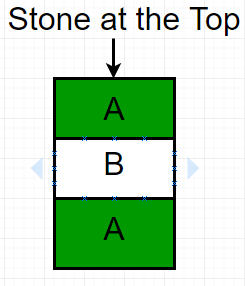
Player A remove stone 1 which is at the top, then Player B remove stone 2
and finally player A removes the last stone.

Input : N = 15.
Output : Player A
For N = 1, player A will remove the only stone from the pile and wins the game.
For N = 2, player A will remove the first stone and then player B remove the second or the last stone. So player B will win the game.
So, we can observe player A wins when N is odd and player B wins when N is even.
Below is the implementation of this approach:
Output :
Player A
Time Complexity: O(1).
Auxiliary Space: O(1)