VOOZH about

URL: https://www.geeksforgeeks.org/dsa/geometric-progression/

⇱ Program to Check Geometric Progression - GeeksforGeeks


  • Courses
  • Tutorials
  • Interview Prep

Program to Check Geometric Progression

Last Updated : 11 Jul, 2025

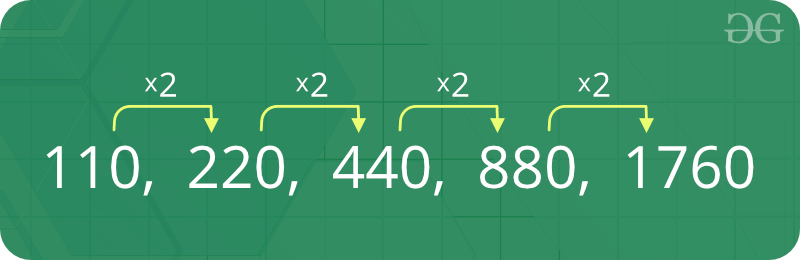
A sequence of numbers is called a Geometric progression if the ratio of any two consecutive terms is always the same.

👁 Image

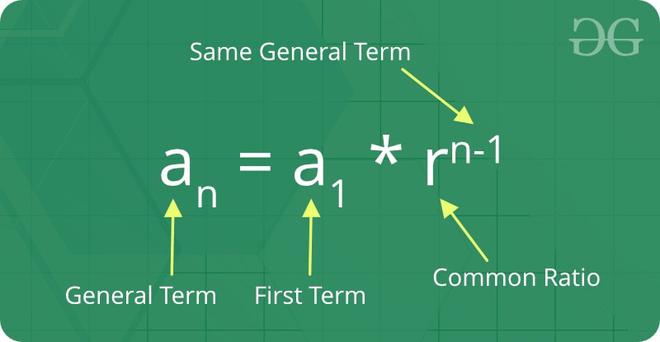
In simple terms, A geometric series is a list of numbers where each number, or term, is found by multiplying the previous term by a common ratio r. The general form of Geometric Progression is:

👁 Image
GP-series

Where,
            a = First term
            r = common ratio
            arn-1 = nth term

Example: 

The sequence 2, 4, 8, 16 is a GP because ratio of any two consecutive terms in the series (common difference) is same (4 / 2 = 8 / 4 = 16 / 8 = 2). 

The geometric progression is of two types:

  1. Finite geometric progression
  2. Infinite geometric progression.

1. Finite geometric progression

In finite geometric progression contains a finite number of terms. The last term is always defined in this type of progression. 

Example:

The sequence 1/2,1/4,1/8,1/16,...,1/32768 is a finite geometric series where the first term is 1/2 and the last term is 1/32768.

2. Infinite geometric progression

Infinite geometric progression contains an infinite number of terms.  The last term is not defined in this type of progression.

Example:

Sequence 3, 9, 27, 81, ... is an infinite series where the first term is 3 but the last term is not defined.

Fact about Geometric Progression:

  1. Initial term: In a geometric progression, the first number is called the initial term.
  2. Common ratio: The ratio between a term in the sequence and the term before it is called the "common ratio." 
  3. The behavior of a geometric sequence depends on the value of the common ratio. If the common ratio is:
    • Positive, the terms will all be the same sign as the initial term.
    • Negative, the terms will alternate between positive and negative.
    • Greater than 1, there will be exponential growth towards positive or negative infinity (depending on the sign of the initial term). 
    • 1, the progression is a constant sequence.
    • Between -1 and 1 but not zero, there will be exponential decay towards zero.
    • -1, the progression is an alternating sequence.
    • Less than -1, for the absolute values there is exponential growth towards (unsigned) infinity, due to the alternating sign.

The formula for the nth term of a Geometric Progression:

If ‘a1' is the first term and ‘r’ is the common ratio. Thus, the explicit formula for nthterm of finite GP series:

👁 Image
 Nth term of a Geometric Progression

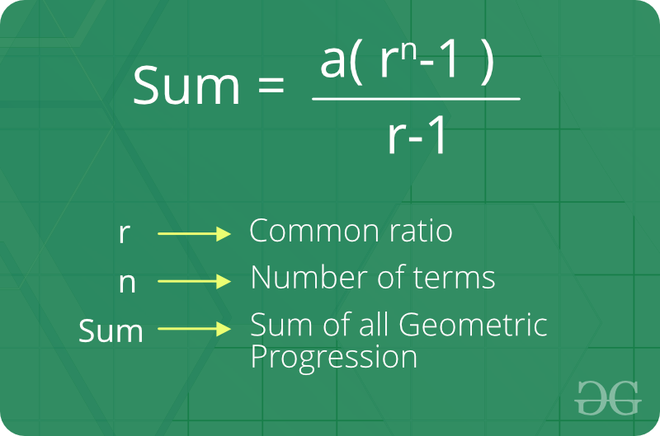
The formula for the sum of the nth term of Geometric Progression: 

👁 Image
Sum of the Nth term of Geometric Progression

How do we check whether a series is a Geometric progression or not?

The property of the GP series is that the ratio of the consecutive terms is same. 

Approach: 

  1. First calculate the common ratio r by arr[1] / arr[0]
  2. Iterate over an array and calculate the ratio of the consecutive terms.
  3. Check if the calculated ratio is not equal to the common ratio r
    • Return false
  4. After traversal, if the calculated ratio is equal to the common ratio r every time 
    • Return true

Below is the implementation of the above approach:


Output
True

Time Complexity: O(n), Where n is the length of the given array.

Auxiliary Space: O(1)

Basic Program related to Geometric Progression 

More problems related to Geometric Progression 

Recent Articles on Geometric Progression!

Comment
Article Tags:
Article Tags: