|
VOOZH | about |
|
VOOZH | about |
Prerequisite:
NP CompleteGiven a ground set X of elements and also a grouping collection C of subsets available in X and an integer k, the task is to find the smallest subset of X, such that the smallest subset, H hits every set comprised in C. This implies that the intersection of H and S is null for every set S belonging to C, with size ≤ k.
An instance of the problem is an input specified to the problem. An instance of the Hitting Set is a collection C of subset, S in X, and k. Since an NP-complete problem, by definition, is a problem which is both NP and NP-Hard, the proof or statement that a problem is NP-Complete consists of two parts:
If the only second condition is satisfied, the problem is called NP-Hard.
But it is not possible to reduce every NP problem into another NP problem to show its NP-Completeness all the time. That is why to show a problem is NP-complete, prove that the problem is in NP and any NP-Complete problem is reducible to that then we are done. Thus, it can be verified that the hitting set problem is NP-Complete using the following propositions:
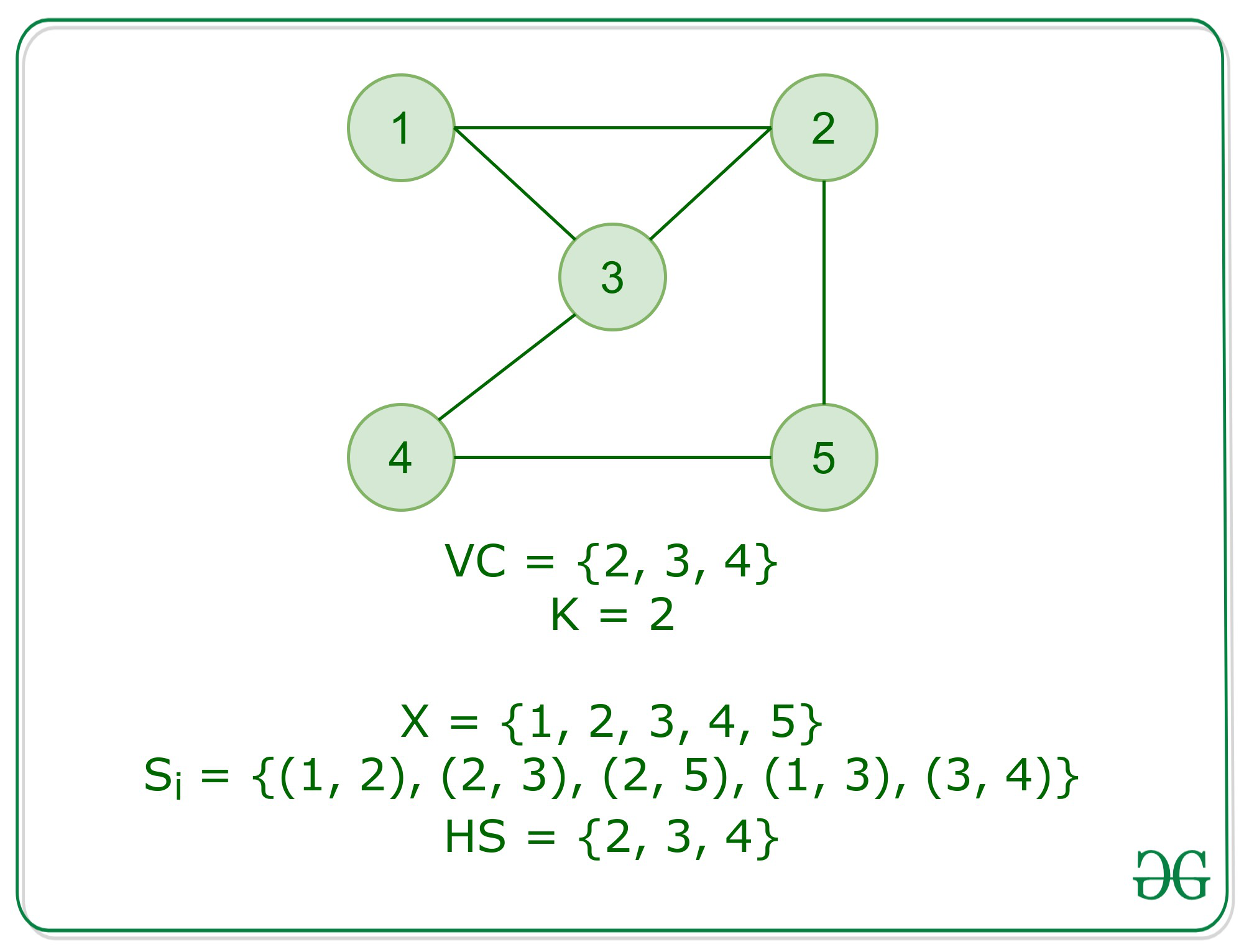
In the Vertex Cover problem, we have a graph G = (V, E)
Now, Let X, that is the ground set = vertices of G. That is X = V(G) and the collection C of subset Si in X is Si = {u, v} is an edge in graph G.
Now, the following properties hold:
The Hitting Set Problem is NP and NP-Hard. Therefore, the Hitting Set Problemis NP-Complete.