|
VOOZH | about |
|
VOOZH | about |
AVL tree is a self-balancing Binary Search Tree (BST) where the difference between heights of left and right subtrees cannot be more than one for all nodes.
Insertion in an AVL Tree follows the same basic rules as in a Binary Search Tree (BST):
The above tree is AVL tree because the differences between the heights of left and right subtrees for every node are lies in the range -1 to +1.
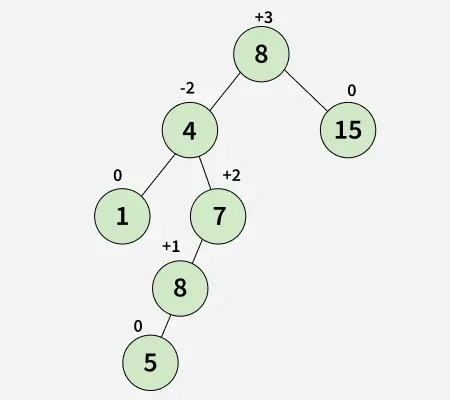
The above tree is not an AVL tree because the differences between the heights of the left and right subtrees for 8 and 12 are greater than 1.
Why AVL Trees? Most of the BST operations (e.g., search, max, min, insert, delete, floor and ceiling) take O(h) time where h is the height of the BST. The cost of these operations may become O(n) for a skewed Binary tree. If we make sure that the height of the tree remains O(log(n)) after every insertion and deletion, then we can guarantee an upper bound of O(log(n)) for all these operations. The height of an AVL tree is always O(log(n)) where n is the number of nodes in the tree.
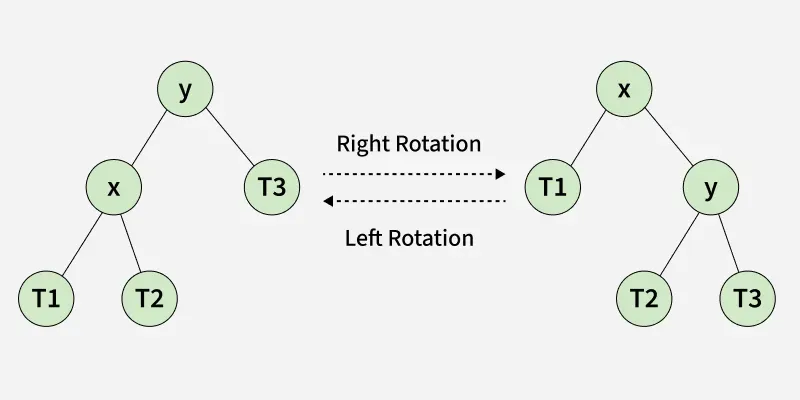
To make sure that the given tree remains AVL after every insertion, we must augment the standard BST insert operation to perform some re-balancing. Following are two basic operations that can be performed to balance a BST without violating the BST property (keys(left) < key(root) < keys(right)).
Approach: The idea is to use recursive BST insert, after insertion, we get pointers to all ancestors one by one in a bottom-up manner. So we don't need a parent pointer to travel up. The recursive code itself travels up and visits all the ancestors of the newly inserted node.
Follow the steps mentioned below to implement the idea:
Below is the implementation of the above approach:
30 20 10 25 40 50
Time Complexity: O(logn), for Insertion
Auxiliary Space: O(logn), for recursion call stack as we have written a recursive method to insert
The rotation operations (left and right rotate) take constant time as only a few pointers are being changed there. Updating the height and getting the balance factor also takes constant time. So the time complexity of the AVL insert remains the same as the BST insert which is O(h) where h is the height of the tree. Since the AVL tree is balanced, the height is O(logn). So time complexity of AVL insert is O(logn).
The AVL tree and other self-balancing search trees like Red Black are useful to get all basic operations done in O(logn) time. The AVL trees are more balanced compared to Red-Black Trees, but they may cause more rotations during insertion and deletion. So if your application involves many frequent insertions and deletions, then Red Black trees should be preferred. And if the insertions and deletions are less frequent and search is the more frequent operation, then the AVL tree should be preferred over Red Black Tree.