|
VOOZH | about |
|
VOOZH | about |
Consider a situation where we have a set of intervals and we need the following operations to be implemented efficiently:
An Interval Tree can be implemented as an augmented binary-search tree (preferably self-balancing), and thus enable us to perform the required operations in O(logN) time complexity.
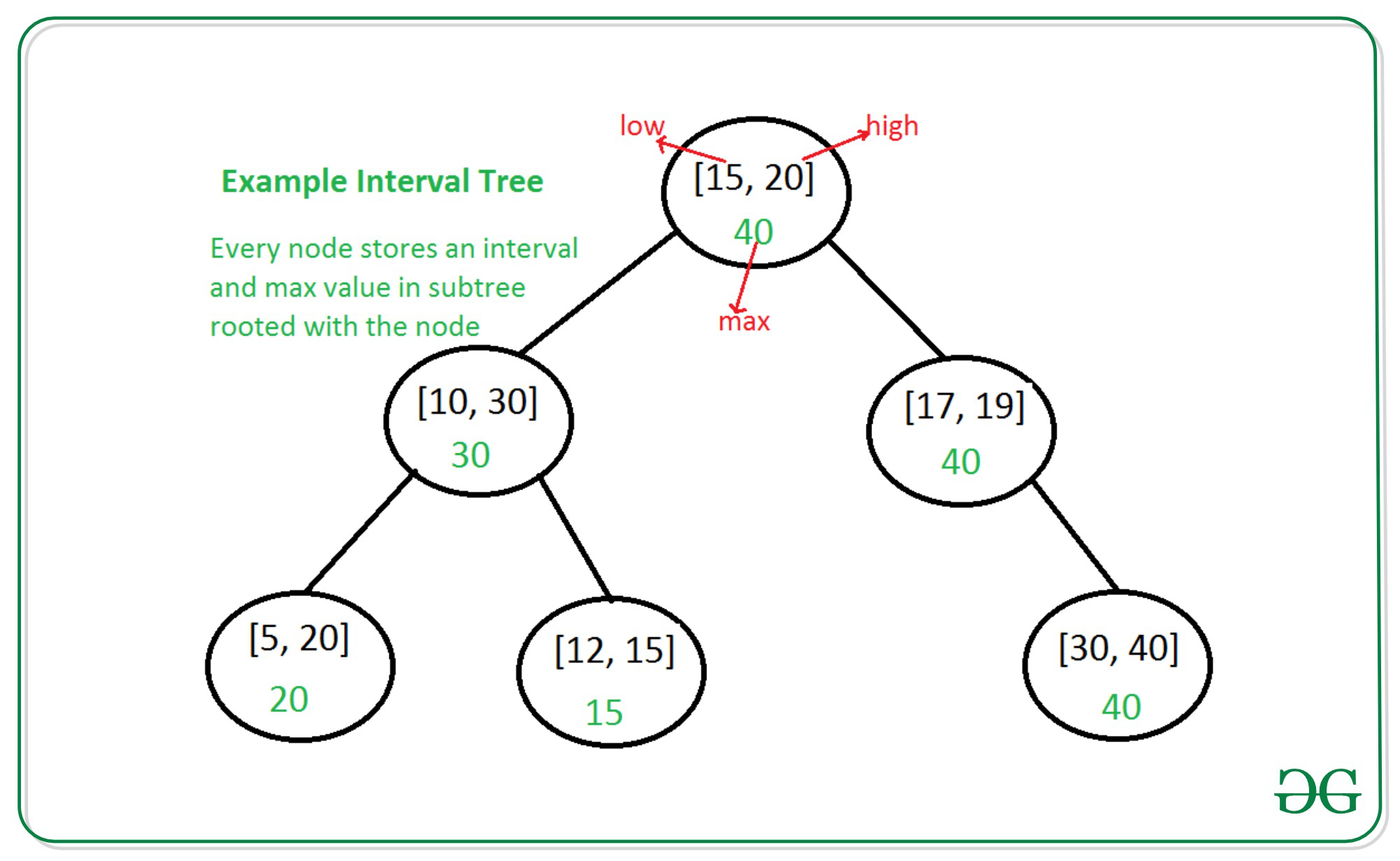
Each node of the tree will store the following information:
Example Interval Tree used in Interval Tree | Set 1:
In Interval Tree | Set 1, we saw how to implement an interval tree using a simple BST (which is not self-balancing). In this article, we will use the built-in GNU tree-based container to implement an Interval Tree. The benefits of doing so are:
We will be using GNU policy-based implementation of tree data structure.
The article Policy-based data structures in g++ introduce GNU policy-based data structure along with the required header files.
We will define our own Node_update policy such that we can maintain the maximum of right-endpoints of intervals in the subtree as metadata in the nodes of our tree.
The syntax for defining a custom Node_policy is:
C++#include <iostream> // Include the iostream header for cout and endl
#include <functional> // For std::function
// Define a custom node update policy struct
template <
typename Const_Node_Iterator, // Constant node iterator type
typename Node_Iterator, // Node iterator type
typename Cmp_Fn_, // Comparator function type
typename Allocator_> // Allocator type
struct custom_node_update_policy {
// Define a nested struct to represent metadata type
struct metadata_type {
// Define members of metadata type here
};
// Define a method similar to the apply() method in Java
void apply(Node_Iterator it,
Const_Node_Iterator endIt)
{
// Implementation of the method
// Note: C++ doesn't have function objects like Java
}
// Other methods can be added here as needed
};
using std::cout; // Import cout into the global namespace
using std::endl; // Import endl into the global namespace
int main() {
// Your program logic goes here
// You can create instances of
// custom_node_update_policy and call its methods
// For example:
custom_node_update_policy<int, int,
std::function<int(int)>,
void*> policy;
policy.apply(10, 20); // Example call to apply method
// Output to demonstrate that the program is running
cout << "Program executed successfully." << endl;
return 0;
}
import java.util.function.Function;

public class Program {
 // Define a generic class with type parameters
 public static class CustomNodeUpdatePolicy<
 ConstNodeIterator, NodeIterator, CmpFn, Allocator> {
 // Define a nested class to represent metadata type
 public class MetadataType {
 // Define members of metadata type here
 }

 // Define a method similar to the operator() in C++
 public void apply(NodeIterator it,
 ConstNodeIterator endIt)
 {
 // Implementation of the method
 // Note: Java doesn't have operator overloading
 // like C++
 }

 // Other methods can be added here as needed
 }

 public static void main(String[] args)
 {
 // Your program logic goes here
 // You can create instances of
 // CustomNodeUpdatePolicy and call its methods For
 // example:
 CustomNodeUpdatePolicy<Integer, Integer,
 Function<Integer, Integer>,
 Object> policy
 = new CustomNodeUpdatePolicy<>();
 policy.apply(10,
 20); // Example call to apply method

 // Output to demonstrate that the program is running
 System.out.println(
 "Program executed successfully.");
 }
}using System;
public class Program
{
// Define a generic class with type parameters
public class CustomNodeUpdatePolicy<ConstNodeIterator, NodeIterator, CmpFn, Allocator>
{
// Define a nested class to represent metadata type
public class MetadataType
{
// Define members of metadata type here
}
// Define a method similar to the operator() in C++
public void Apply(NodeIterator it, ConstNodeIterator endIt)
{
// Implementation of the method
// Note: C# doesn't have operator overloading like C++
}
// Other methods can be added here as needed
}
public static void Main(string[] args)
{
// Your program logic goes here
// You can create instances of CustomNodeUpdatePolicy and call its methods
// For example:
CustomNodeUpdatePolicy<int, int, Func<int, int, int>, object> policy = new CustomNodeUpdatePolicy<int, int, Func<int, int, int>, object>();
policy.Apply(10, 20); // Example call to Apply method
// Output to demonstrate that the program is running
Console.WriteLine("Program executed successfully.");
}
}
// Define a generic class with type parameters
class CustomNodeUpdatePolicy {
 constructor(ConstNodeIterator, NodeIterator, CmpFn, Allocator) {
 this.ConstNodeIterator = ConstNodeIterator;
 this.NodeIterator = NodeIterator;
 this.CmpFn = CmpFn;
 this.Allocator = Allocator;
 }

 // Define a nested class to represent metadata type
 MetadataType() {
 // Define members of metadata type here
 }

 // Define a method similar to the operator() in Python
 apply(it, endIt) {
 // Implementation of the method
 // Note: JavaScript doesn't have operator overloading like Python
 }

 // Other methods can be added here as needed
}

// Your program logic goes here
// You can create instances of CustomNodeUpdatePolicy and call its methods
// For example:
const policy = new CustomNodeUpdatePolicy(Number, Number, (x, y) => x + y, Object);
policy.apply(10, 20); // Example call to Apply method

// Output to demonstrate that the program is running
console.log("Program executed successfully.");
# Define a generic class with type parameters
class CustomNodeUpdatePolicy:
 def __init__(self, ConstNodeIterator, NodeIterator, CmpFn, Allocator):
 self.ConstNodeIterator = ConstNodeIterator
 self.NodeIterator = NodeIterator
 self.CmpFn = CmpFn
 self.Allocator = Allocator

 # Define a nested class to represent metadata type
 class MetadataType:
 pass
 # Define members of metadata type here

 # Define a method similar to the operator() in C++
 def apply(self, it, endIt):
 pass
 # Implementation of the method
 # Note: Python doesn't have operator overloading like C++

 # Other methods can be added here as needed

# Your program logic goes here
# You can create instances of CustomNodeUpdatePolicy and call its methods
# For example:
policy = CustomNodeUpdatePolicy(int, int, lambda x, y: x + y, object)
policy.apply(10, 20) # Example call to Apply method

# Output to demonstrate that the program is running
print("Program executed successfully.")
Program executed successfully.
See GNU tree-based containers for more details.
We will also define a method overlapSearch which searches for any interval in the tree overlapping with a given interval i.
// pseudocode for overlapSearch
Interval overlapSearch(Interval i) {
 // start from root
 it = root_node
 while (it not null) {
 if (doOVerlap(i, it->interval)) {
 // overlap found
 return it->interval
 }
 if (left_child exists
 AND
 left_child->max_right_endpoint
 >= it->left_endpoint) {
 // go to left child
 it = it->left_child
 }
 else {
 // go to right child
 it = it->right_child
 }
 }
 // no overlapping interval found
 return NO_INTERVAL_FOUND
}
Below is the implementation of the Interval Tree:
C++// CPP program for above approach
#include <bits/stdc++.h>
#include <ext/pb_ds/assoc_container.hpp>
using namespace std;
using namespace __gnu_pbds;
typedef pair<int, int> Interval;
// An invalid interval, used as
// return value to denote that no
// matching interval was found
const Interval NO_INTERVAL_FOUND = { 1, 0 };
// interval update policy struct
template <class Node_CItr,
class Node_Itr,
class Cmp_Fn, class _Alloc>
struct interval_node_update_policy {
// Our metadata is maximum of
// right-endpoints of intervals in the
// sub-tree, which is of type int
typedef int metadata_type;
// An utility function to check
// if given two intervals overlap
bool doOverlap(Interval i1,
Node_CItr i2)
{
return (i1.first <= (*i2)->second
&& (*i2)->first <= i1.second);
}
// Search for any interval that
// overlaps with Interval i
Interval overlapSearch(Interval i)
{
for (Node_CItr it = node_begin();
it != node_end();) {
if (doOverlap(i, it)) {
return { (*it)->first,
(*it)->second };
}
if (it.get_l_child() != node_end()
&& it.get_l_child()
.get_metadata()
>= i.first) {
it = it.get_l_child();
}
else {
it = it.get_r_child();
}
}
return NO_INTERVAL_FOUND;
}
// To restore the node-invariance
// of the node pointed to by
// (it). We need to derive the
// metadata for node (it) from
// its left-child and right-child.
void operator()(Node_Itr it,
Node_CItr end_it)
{
int max_high = (*it)->second;
if (it.get_l_child() != end_it) {
max_high = max(
max_high,
it.get_l_child()
.get_metadata());
}
if (it.get_r_child() != end_it) {
max_high = max(
max_high,
it.get_r_child()
.get_metadata());
}
// The max of right-endpoint
// of this node and the max
// right-endpoints of children.
const_cast<int&>(
it.get_metadata())
= max_high;
}
virtual Node_CItr node_begin() const = 0;
virtual Node_CItr node_end() const = 0;
virtual ~interval_node_update_policy() {}
};
// IntervalTree data structure
// rb_tree_tag: uses red-black search tree
// interval_node_update_policy:
// our custom Node_update policy
typedef tree<Interval,
null_type,
less<Interval>,
rb_tree_tag,
interval_node_update_policy>
IntervalTree;
// Driver Code
int main()
{
IntervalTree IT;
Interval intvs[] = { { 15, 20 },
{ 10, 30 },
{ 17, 19 },
{ 5, 20 },
{ 12, 15 },
{ 30, 40 } };
for (Interval intv : intvs) {
IT.insert(intv);
}
Interval toSearch = { 25, 29 };
cout << "\nSearching for interval ["
<< toSearch.first << ", "
<< toSearch.second << "]";
Interval res = IT.overlapSearch(toSearch);
if (res == NO_INTERVAL_FOUND)
cout << "\nNo Overlapping Interval\n";
else
cout << "\nOverlaps with ["
<< res.first << ", "
<< res.second << "]\n";
Interval toErase = { 10, 30 };
IT.erase(toErase);
cout << "\nDeleting interval ["
<< toErase.first << ", "
<< toErase.second
<< "]\n";
cout << "\nSearching for interval ["
<< toSearch.first << ", "
<< toSearch.second << "]";
res = IT.overlapSearch(toSearch);
if (res == NO_INTERVAL_FOUND)
cout << "\nNo Overlapping Interval\n";
else
cout << "\nOverlaps with ["
<< res.first << ", "
<< res.second << "]\n";
return 0;
}import java.util.Comparator;
import java.util.TreeSet;
// Class to represent intervals
class Interval {
int first, second;
public Interval(int first, int second) {
this.first = first;
this.second = second;
}
}
// Class representing the Interval Tree
class IntervalTree {
TreeSet<Interval> treeSet;
// Constructor for IntervalTree class
public IntervalTree() {
// Use a TreeSet with a custom comparator based on the second endpoint of intervals
treeSet = new TreeSet<>(Comparator.comparingInt(interval -> interval.second));
}
// Method to insert an interval into the tree
public void insert(Interval interval) {
treeSet.add(interval);
}
// Method to search for any interval that overlaps with the given interval
public Interval overlapSearch(Interval interval) {
for (Interval i : treeSet) {
if (doOverlap(interval, i)) {
return new Interval(i.first, i.second);
}
}
return NO_INTERVAL_FOUND;
}
// Method to remove an interval from the tree
public void erase(Interval interval) {
treeSet.remove(interval);
}
// Helper method to check if two intervals overlap
private boolean doOverlap(Interval i1, Interval i2) {
return (i1.first <= i2.second && i2.first <= i1.second);
}
// Declare NO_INTERVAL_FOUND as static or public
public static final Interval NO_INTERVAL_FOUND = new Interval(1, 0);
}
// Main class to test the IntervalTree
public class Main {
public static void main(String[] args) {
IntervalTree IT = new IntervalTree();
Interval[] intvs = {
new Interval(15, 20),
new Interval(10, 30),
new Interval(17, 19),
new Interval(5, 20),
new Interval(12, 15),
new Interval(30, 40)
};
// Insert intervals into the tree
for (Interval intv : intvs) {
IT.insert(intv);
}
// Search for overlapping interval
Interval toSearch = new Interval(25, 29);
System.out.println("Searching for interval [" + toSearch.first + ", " + toSearch.second + "]");
Interval res = IT.overlapSearch(toSearch);
if (res == IntervalTree.NO_INTERVAL_FOUND)
System.out.println("No Overlapping Interval");
else
System.out.println("Overlaps with [" + res.first + ", " + res.second + "]");
// Remove an interval from the tree
Interval toErase = new Interval(10, 30);
IT.erase(toErase);
System.out.println("Deleting interval [" + toErase.first + ", " + toErase.second + "]");
// Search for overlapping interval after deletion
System.out.println("Searching for interval [" + toSearch.first + ", " + toSearch.second + "]");
res = IT.overlapSearch(toSearch);
if (res == IntervalTree.NO_INTERVAL_FOUND)
System.out.println("No Overlapping Interval");
else
System.out.println("Overlaps with [" + res.first + ", " + res.second + "]");
}
}
using System;
using System.Collections.Generic;

// Class representing an interval
class Interval
{
 public int Start { get; set; }
 public int End { get; set; }

 public Interval(int start, int end)
 {
 Start = start;
 End = end;
 }
}

// Class representing an Interval Tree
class IntervalTree
{
 private readonly SortedSet<Interval> intervals;

 public IntervalTree()
 {
 intervals = new SortedSet<Interval>(Comparer<Interval>.Create((a, b) => a.Start.CompareTo(b.Start)));
 }

 // Insert an interval into the Interval Tree
 public void Insert(Interval interval)
 {
 intervals.Add(interval);
 }

 // Search for any interval that overlaps with the given query interval
 public Interval OverlapSearch(Interval queryInterval)
 {
 foreach (var interval in intervals)
 {
 if (DoOverlap(queryInterval, interval))
 {
 return interval;
 }
 }
 return null;
 }

 // Remove an interval from the Interval Tree
 public void Erase(Interval interval)
 {
 intervals.Remove(interval);
 }

 // Check if two intervals overlap
 private bool DoOverlap(Interval i1, Interval i2)
 {
 return (i1.Start <= i2.End && i2.Start <= i1.End);
 }
}

class Program
{
 static void Main()
 {
 IntervalTree intervalTree = new IntervalTree();
 Interval[] intervals = {
 new Interval(15, 20),
 new Interval(10, 30),
 new Interval(17, 19),
 new Interval(5, 20),
 new Interval(12, 15),
 new Interval(30, 40)
 };

 // Insert intervals into the Interval Tree
 foreach (var interval in intervals)
 {
 intervalTree.Insert(interval);
 }

 Interval toSearch = new Interval(25, 29);
 Console.Write($"\nSearching for interval [{toSearch.Start}, {toSearch.End}]: ");
 Interval result = intervalTree.OverlapSearch(toSearch);
 if (result == null)
 Console.WriteLine("No Overlapping Interval");
 else
 Console.WriteLine($"Overlaps with [{result.Start}, {result.End}]");

 Interval toErase = new Interval(10, 30);
 intervalTree.Erase(toErase);
 Console.Write($"\nDeleting interval [{toErase.Start}, {toErase.End}]: ");

 Console.Write($"\nSearching for interval [{toSearch.Start}, {toSearch.End}]: ");
 result = intervalTree.OverlapSearch(toSearch);
 if (result == null)
 Console.WriteLine("No Overlapping Interval");
 else
 Console.WriteLine($"Overlaps with [{result.Start}, {result.End}]");
 }
}
// JavaScript Program for the above approach
// Define a Node class representing a node in the interval tree
class Node {
 constructor(interval) {
 this.interval = interval;
 this.max = interval[1];
 this.left = null;
 this.right = null;
 }
}

// Define an IntervalTree class to manage the interval tree operations
class IntervalTree {
 constructor() {
 this.root = null;
 }

 // insert a new interval into the interval tree
 insert(root, interval) {
 if (!root) {
 return new Node(interval);
 }
 if (interval[0] < root.interval[0]) {
 root.left = this.insert(root.left, interval);
 } else {
 root.right = this.insert(root.right, interval);
 }
 root.max = Math.max(root.max, interval[1]);
 return root;
 }

 // check for interval operlap in the interval tree
 overlap(root, interval) {
 if (!root) {
 return null;
 }
 if (root.interval[0] <= interval[1] && root.interval[1] >= interval[0]) {
 return root.interval;
 }
 if (root.left && root.left.max >= interval[0]) {
 return this.overlap(root.left, interval);
 }
 return this.overlap(root.right, interval);
 }

 // delete an interval from the interval tree
 delete(root, interval) {
 if (!root) {
 return root;
 }
 if (interval[0] < root.interval[0]) {
 root.left = this.delete(root.left, interval);
 } else if (interval[0] > root.interval[0]) {
 root.right = this.delete(root.right, interval);
 } else {
 if (!root.left) {
 let temp = root.right;
 root = null;
 return temp;
 } else if (!root.right) {
 let temp = root.left;
 root = null;
 return temp;
 }
 let temp = this.minValueNode(root.right);
 root.interval = temp.interval;
 root.right = this.delete(root.right, temp.interval);
 }
 return root;
 }

 // helper function to find the node with the minimum value in subtree
 minValueNode(root) {
 let current = root;
 while (current.left !== null) {
 current = current.left;
 }
 return current;
 }
}

// Example usage of the IntervalTree
const intervals = [[15, 20], [10, 30], [17, 19], [5, 20], [12, 15], [30, 40]];
const IT = new IntervalTree();

for (const interval of intervals) {
 IT.root = IT.insert(IT.root, interval);
}

// Search for an interval and print the result
const to_search = [25, 29];
console.log(`Searching for interval ${JSON.stringify(to_search)}`);
let res = IT.overlap(IT.root, to_search);
if (res) {
 console.log(`Overlaps with ${JSON.stringify(res)}`);
} else {
 console.log("No Overlapping Interval");
}

// Delete an interval and print the result
const to_erase = [10, 30];
console.log(`Deleting interval ${JSON.stringify(to_erase)}`);
IT.root = IT.delete(IT.root, to_erase);

// Search for an interval again after deletion and print the result
console.log(`Searching for interval ${JSON.stringify(to_search)}`);
res = IT.overlap(IT.root, to_search);
if (res) {
 console.log(`Overlaps with ${JSON.stringify(resultAfterDeletion)}`);
} else {
 console.log("No Overlapping Interval");
}
// This code is contributed by Yash Agarwal(yashagarwal2852002)# Define a Node class representing a node in the interval tree
class Node:
def __init__(self, interval):
self.interval = interval
self.max = interval[1]
self.left = None
self.right = None
# Define an IntervalTree class to manage the interval tree operations
class IntervalTree:
def __init__(self):
self.root = None
# Insert a new interval into the interval tree
def insert(self, root, interval):
if not root:
return Node(interval)
if interval[0] < root.interval[0]:
root.left = self.insert(root.left, interval)
else:
root.right = self.insert(root.right, interval)
root.max = max(root.max, interval[1])
return root
# Check for interval overlap in the interval tree
def overlap(self, root, interval):
if not root:
return None
if (root.interval[0] <= interval[1] and root.interval[1] >= interval[0]):
return root.interval
if root.left and root.left.max >= interval[0]:
return self.overlap(root.left, interval)
return self.overlap(root.right, interval)
# Delete an interval from the interval tree
def delete(self, root, interval):
if not root:
return root
if interval[0] < root.interval[0]:
root.left = self.delete(root.left, interval)
elif interval[0] > root.interval[0]:
root.right = self.delete(root.right, interval)
else:
if root.left is None:
temp = root.right
root = None
return temp
elif root.right is None:
temp = root.left
root = None
return temp
temp = self.minValueNode(root.right)
root.interval = temp.interval
root.right = self.delete(root.right, temp.interval)
return root
# Helper function to find the node with the minimum value in a subtree
def minValueNode(self, root):
current = root
while(current.left is not None):
current = current.left
return current
# Example usage of the IntervalTree
intervals = [(15, 20), (10, 30), (17, 19), (5, 20), (12, 15), (30, 40)]
IT = IntervalTree()
for interval in intervals:
IT.root = IT.insert(IT.root, interval)
# Search for an interval and print the result
to_search = (25, 29)
print(f"Searching for interval {to_search}")
res = IT.overlap(IT.root, to_search)
if res:
print(f"Overlaps with {res}")
else:
print("No Overlapping Interval")
# Delete an interval and print the result
to_erase = (10, 30)
print(f"Deleting interval {to_erase}")
IT.root = IT.delete(IT.root, to_erase)
# Search for an interval again after deletion and print the result
print(f"Searching for interval {to_search}")
res = IT.overlap(IT.root, to_search)
if res:
print(f"Overlaps with {res}")
else:
print("No Overlapping Interval")
Searching for interval [25, 29]
Overlaps with [10, 30]

Deleting interval [10, 30]

Searching for interval [25, 29]
No Overlapping Interval
Time Complexity : O(log N), All operations are logarithmic in size, i.e. O(logN), where N is the number of intervals stored in the tree.
Auxiliary Space: O(N)
We are able to achieve logarithmic worst-case complexity because a red-black tree is used internally which is self-balancing.