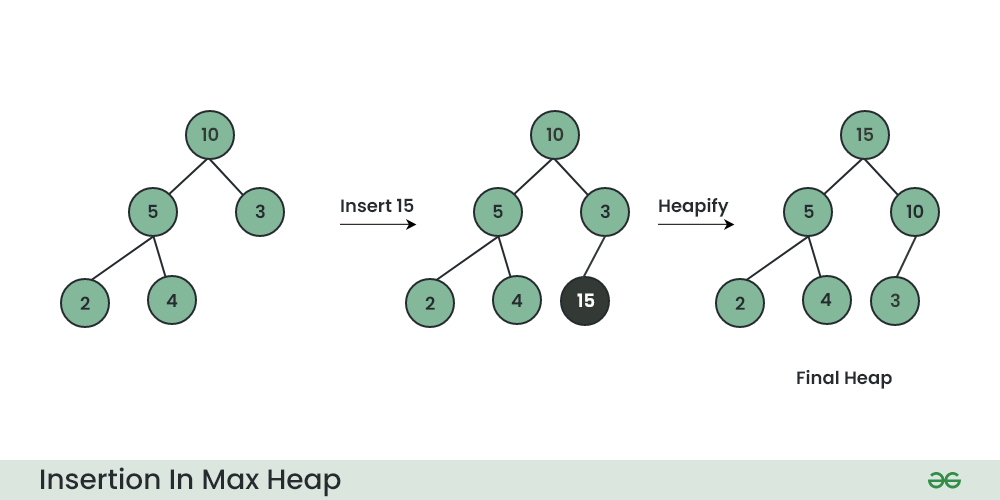
Inserted 10 into the max-heap: 10
Inserted 7 into the max-heap: 10 7
Inserted 11 into the max-heap: 11 7 10
Inserted 5 into the max-heap: 11 7 10 5
Inserted 4 into the max-heap: 11 7 10 5 4
Inser...
Deletion - O(log n) Time and O(n) Space
Removing the largest element (the root) from a Max-Heap involves the following steps:
Replace the root (or the element to be deleted) with the last element in the heap.
Remove the last element from the heap, since it has been moved to the root.
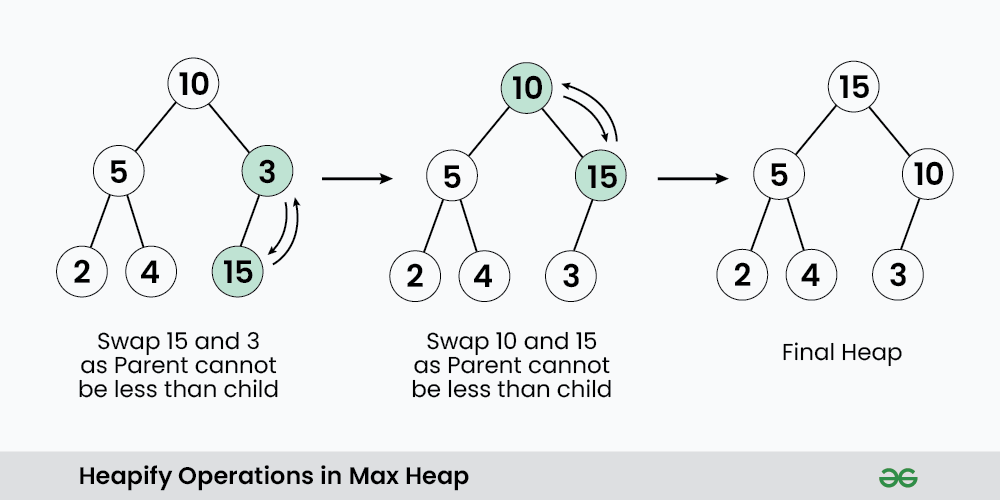
Heapify-down: The element now at the root may violate the Max-Heap property, so perform heapify starting from the root to restore the heap property.
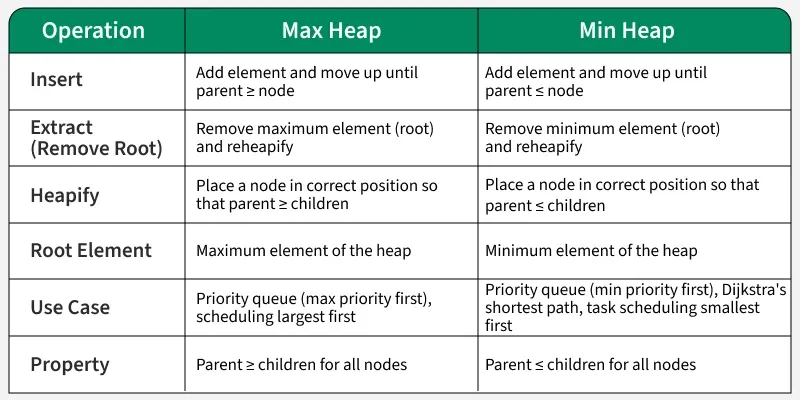
Heapify is an operation that places a node in its correct position in a heap so that the subtree rooted at that node satisfies the heap property. To build a max heap from an unsorted array, we start from the last non-leaf node and move up to the root, calling heapify on each node. For each node, if it is smaller than any of its children, we swap it with the largest child and continue until it is larger than both children. After all nodes are processed, the array becomes a valid max heap.
Heap Sort: Heaps are used in the heap sort algorithm, an efficient sorting method with worst-case time complexity of O(n log n), applied in database indexing and numerical analysis.
Memory Management: Heaps help allocate and deallocate memory dynamically, managing memory blocks efficiently for programs.
Graph Algorithms: Heaps are used in algorithms like Dijkstra, Prim, and Kruskal to implement efficient priority queues.
Job Scheduling: Heaps enable quick access to highest-priority tasks, making them ideal for task scheduling based on priority or deadlines.
Advantages of Max-Heap Data Structure
Quick access to maximum: Max-heap allows O(1) access to the largest element.
Efficient insert/delete: Both operations take O(log n), making it suitable for large datasets.
Priority Queues: Max-heap can implement priority queues for job scheduling, task prioritization, and event-driven simulations.
Heap Sort: Can be used for heap sort, an efficient O(n log n) sorting algorithm.
Space Efficient: Can be implemented as an array, using less memory than BSTs or linked lists.