|
VOOZH | about |
|
VOOZH | about |
A sequence is a list of numbers arranged in a specific order, following a particular rule. Each number in the sequence is called a term.
In mathematics, a sequence is an ordered list of numbers, where each number in the list is called a term. Sequences are defined by a specific rule that determines how each term is generated from its predecessor.
Example:
Sequence: 2, 4, 6, 8, 10,…
Rule: Add 2 to the previous term to get the next term.
Table of Content
Order of a sequence in mathematics refers to the arrangement of its terms based on their position or value, usually indexed by natural numbers. There are generally two types of order of sequences:
When we talk about the ascending order of a sequence, we refer to arranging the terms of the sequence from the smallest to the largest. This concept is straightforward and is commonly used to organize data in a manner that is easy to analyze and understand.
Examples of Sequences in Ascending Order:
- Original Sequence: 7, 2, 9, 4, 5
- Ascending Order: 2, 4, 5, 7, 9
- Original Sequence: 2, 5, 8, 11, 14, ...
- Ascending Order: 2, 5, 8, 11, 14, ...
When we talk about the descending order of a sequence, we refer to arranging the terms of the sequence from the largest to the smallest. This is the opposite of ascending order and is commonly used to prioritize data based on magnitude.
Examples of Sequences in Descending Order:
- Original Sequence: 7, 2, 9, 4, 5
- Descending Order: 9, 7, 5, 4, 2
- Original Sequence: 14, 11, 8, 5, 2, ...
- Descending Order: 14, 11, 8, 5, 2, ...
In mathematics, sequences can be classified as either finite or infinite based on the number of terms they contain. Let's learn about them in detail.
A finite sequence has a limited number of terms. It starts at a specific term and ends at a specific term.
Example:
An infinite sequence has an unlimited number of terms. It continues indefinitely without terminating.
Example:
There are many types of sequences but mostly four types of sequences are well known, let's take a look at these 4 types,
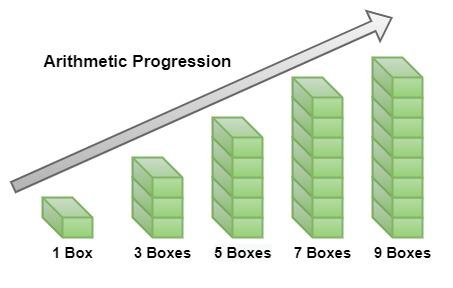
In an arithmetic sequence, the difference between consecutive terms is always the same. For example, the sequence 5, 9, 13, 17... is arithmetic because the difference between consecutive terms is always four.
The difference between a sequence and a progression is that to calculate its nth term, a progression has a specific formula i.e,
Tn = a + (n - 1)d
Which is the formula of the nth term of an arithmetic progression.
A geometric sequence goes from one term to the next by always multiplying or dividing by the same value. The number multiplied (or divided) at each stage of a geometrical sequence is named the common ratio.
The formula for the nth term of the geometric sequence is, where a1 is the first term, r is the common ratio, and an is the nth term,
an = a1 rn-1
The sum of n terms in Geometric Sequence is:
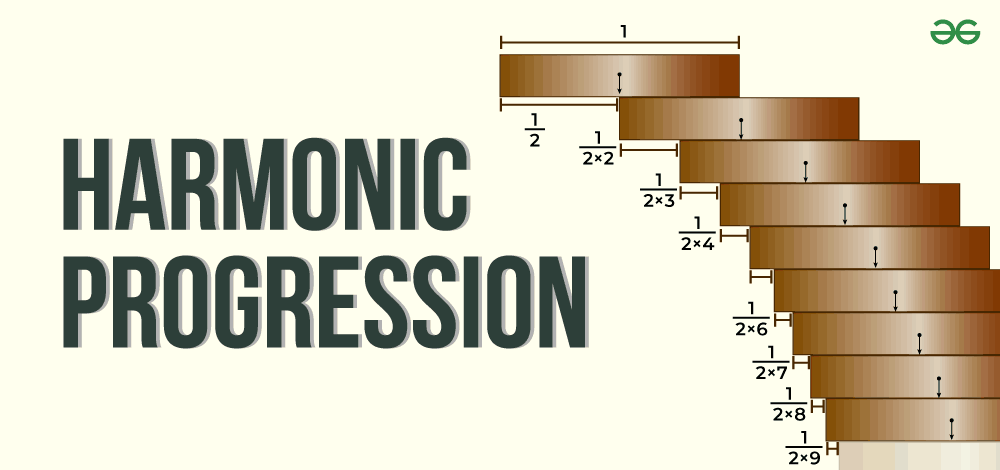
👁 Geometric-SequencesHarmonic sequence, in mathematics, a sequence of numbers a1, a2, a3,… such their reciprocals 1/ a1, 1/ a2, 1/ a3,… form an arithmetic sequence (numbers separated by a common difference). The arithmetic sequence is just the reciprocal of the harmonic sequence.
The nth term for the harmonic sequence where Tn is the nth term, n is the number of terms, and d is a common difference,
Fibonacci series1, 1, 2, 3, 5, 8, ... is an example of a sequence. The Fibonacci sequence is basically a sequence where the next term is the sum of the earlier 2 terms starting with 1.
Other Sequences in Maths are:
The triangular number sequence is a pattern of numbers that represent the number of dots that can form an equilateral triangle. The n-th triangular number is the number of dots in a triangle with n dots on each side. Formula for the Triangular Number Sequence is added below:
Tn = n(n + 1)/2
Example: 1, 3, 6, 10, ...
The square number sequence is a pattern of numbers that represent the number of dots that can form a perfect square. Each term in the sequence is the square of an integer.
Formula for Sequence Number Sequence is added below:
Sn = n2
Example: 1, 4, 9, 16, ...
The cube number sequence is a pattern of numbers that represent the number of smaller cubes that can form a perfect cube. Each term in the sequence is the cube of an integer.
Cn = n3
Example: 1, 8, 27, 64, ...
Sequences follow specific rules that define how each term is generated. These rules can vary widely depending on the type of sequence.
Various sequence formulas are added in the table below:
Sequences | Formulas |
|---|---|
Arithmetic Sequence | an = a + (n - 1) d |
Geometric Sequence | an = arn-1 |
Fibonacci Sequence | an+2 = an+1 + an |
Square Number Sequence | an = n2 |
Cube Number Sequence | an = n3 |
Triangular Number Sequence | an = ∑k=1n n |
Read More:
Example 1: Find the 17th term of the following arithmetic progression 6, 10, 14, 18, 22, 26, ...
Solution:
Formula of nth term of an A.P. is Tn = a + (n-1)d
Here, a = 6 and d = (10 - 6) = 4
Therefore, 17th term = 6 + (17 - 1) × 4
= 6 + 16 × 4 = 6 + 64 = 70
Example 2: Find the sum of the following arithmetic progression 2, 7, 12, 17, 22, ...., 52
Solution:
Formula of sum of an A.P. when first and last term is given is: [n / 2](a + l)
Here, a = 2, d = 5 and l = 52
Tn = a + (n - 1)dTherefore, 52 = 2 + (n - 1 ) × 5
52 = 2 + 5 × n -5
52 + 3 = 5 × n
55/5 = n
n = 11Therefore, sum = (11/2) × (2 + 52)
= 11/2 × 54
= 11 × 27 = 297
Example 3: Is the given series a Geometric progression: 2, 4, 8, 32, 64, 128.
Solution:
In a geometric progression, the common ratio is a fixed number but in this series we have two common ratio as 4/2 = 2 and 32/8 = 4
Therefore, it's not a geometrical progression.
Example 4: Find the common ratio of the following series: 3, 6, 12, 24, 48, ...
Solution:
Common Ratio = (Current Term)/ (Preceding Term)
= 12/6 = 2


.png)