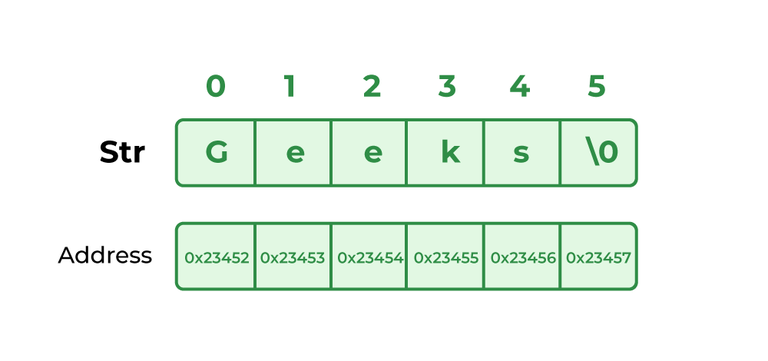
Strings are sequences of characters. The differences between a character array and a string are, a string is terminated with a special character ‘\0’ and strings are typically immutable in most of the programming languages like Java, Python and JavaScript. Below are some examples of strings:
C: Strings are declared as character arrays or pointers and must end with a null character (\0) to indicate termination.
C++: Supports both C-style character arrays and the std::string class, which provides built-in functions for string manipulation.
Java: Strings are immutable objects of the String class, meaning their values cannot be modified once assigned.
Python: Strings are immutable and can be declared using single, double, or triple quotes, making them flexible for multi-line text handling.
JavaScript: Strings are immutable, primitive data types and can be defined using single, double, or template literals (backticks), allowing for interpolation.
C#: Uses the string keyword, which represents an immutable sequence of characters, similar to Java.
There is no character type in Python and JavaScript and a single character is also considered as a string.
Below is the representation of strings in various languages:
Are Strings Mutable in Different Languages?
In C/C++, string literals (assigned to pointers) are immutable.
In C++, string objects are mutable.
In Python, Java and JavaScript, strings are immutable.
General Operations performed on String
Here we are providing you with some must-know concepts of string:
Length of String : The length of a string refers to the total number of characters present in it, including letters, digits, spaces, and special characters. It is a fundamental property of strings in any programming language and is often used in various operations such as validation, manipulation, and comparison.
Search a Character : Searching for a character in a string means finding the position where a specific character appears. If the character is present multiple times, you might need to find its first occurrence, last occurrence, or all occurrences.
Check for Substring : Checking for a substring means determining whether a smaller sequence of characters exists within a larger string. A substring is a continuous part of a string, and checking for its presence is a common operation in text processing, search algorithms, and data validation.
Insert a Character : Inserting a character into a string means adding a new character at a specific position while maintaining the original order of other characters. Since strings are immutable in many programming languages, inserting a character usually involves creating a new modified string with the desired character placed at the specified position.
Delete a Character : Deleting a character from a string means removing a specific character at a given position while keeping the remaining characters intact. Since strings are immutable in many programming languages, this operation usually involves creating a new string without the specified character.
Check for Same Strings : Checking if two strings are the same means comparing them character by character to determine if they are identical in terms of length, order, and content. If every character in one string matches exactly with the corresponding character in another string, they are considered the same.
String Concatenation : String concatenation is the process of joining two or more strings together to form a single string. This is useful in text processing, formatting messages, constructing file paths, or dynamically creating content.
Reverse a String : Reversing a string means arranging its characters in the opposite order while keeping their original positions intact in the reversed sequence. This operation is commonly used in text manipulation, data encryption, and algorithm challenges.
Rotate a StringRotating a string means shifting its characters to the left or right by a specified number of positions while maintaining the order of the remaining characters. The characters that move past the boundary wrap around to the other side.
Check for Palindrome : Checking for a palindrome means determining whether a string reads the same forward and backward. A palindrome remains unchanged when reversed, making it a useful concept in text processing, algorithms, and number theory.