|
VOOZH | about |
|
VOOZH | about |
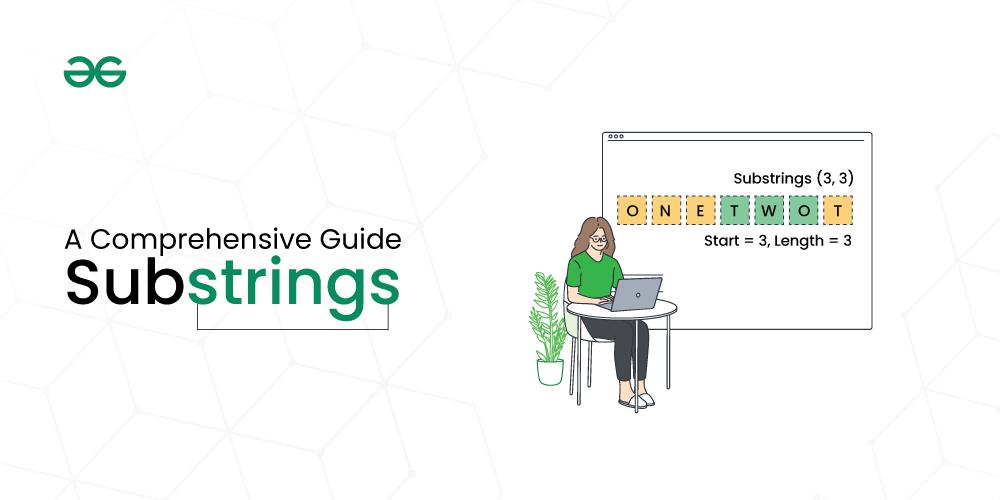
Substrings are a fundamental concept in computer science and programming. They play a crucial role in various applications, from text manipulation to data processing. In this blog post, we'll explore what substrings are, their full form, use cases, examples, when to use them, when to avoid them, best practices, common problems, and other relevant information.
Table of Content
Definition: A substring is a contiguous sequence of characters within a larger string. It is essentially a smaller portion of a string extracted from the original string. Substrings are often used for various text manipulation tasks, including searching, comparing, and extracting data.
Full-Form: Substring is a portmanteau of "sub" and "string," implying a part of a string.
Substrings find applications in a wide range of domains, including:
Let's consider a few examples to illustrate the concept of substrings:
Hello
John Doe
Good evening, sunshine!
You should consider using substrings when:
Avoid using substrings in the following scenarios:
To make the most of substrings, consider these best practices:
Substring: Hello
Problem | Link of the problem |
|---|---|
Number of substrings of one string present in other | |
Print all substring of a number without any conversion | |
Substring Reverse Pattern | |
Find the count of palindromic sub-string of a string in its sorted form | |
Check if a string contains a palindromic sub-string of even length | |
Longest sub string of 0’s in a binary string which is repeated K times | |
Longest substring with atmost K characters from the given set of characters | |
Lexicographically all Shortest Palindromic Substrings from a given string | |
Shortest Palindromic Substring | |
Count of all unique substrings with non-repeating characters | |
Count of substrings of length K with exactly K distinct characters | |
Count of substrings containing only the given character | |
Count of Distinct Substrings occurring consecutively in a given String | |
Check if a String contains Anagrams of length K which does not contain the character X |
Off-by-one errors are common when working with substrings. To avoid them, carefully manage your index positions, and remember that indexing is typically zero-based.
If you need to extract multiple substrings from a large string, consider using regular expressions or more efficient algorithms to avoid performance issues.
When working with different character encodings, be aware that the length of a substring may not be equal to the number of characters it contains. This can lead to unexpected behavior, so handle character encodings properly.
Substrings are a fundamental tool in programming and data processing, allowing you to work with smaller, more manageable parts of larger strings. When used correctly, they can simplify complex tasks, such as text processing and data extraction. However, it's essential to be mindful of potential issues like off-by-one errors and inefficient operations. By following best practices and understanding their use cases and limitations, you can harness the power of substrings effectively in your coding adventures.