Karp's minimum mean (or average) weight cycle algorithm
Last Updated : 23 Jul, 2025
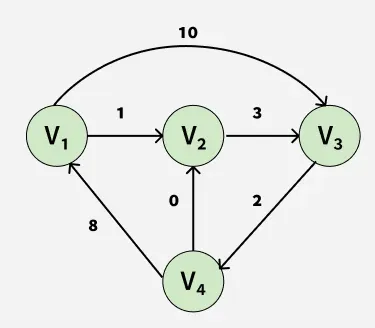
Given a directed and strongly connected graph with non-negative edge weights. We define the mean weight of a cycle as the summation of all the edge weights of the cycle divided by the no. of edges. Our task is to find the minimum mean weight among all the directed cycles of the graph.
The input is provided as a list of edges, where each edge is represented by a triplet [u, v, w] indicating a directed edge from node u to node v with weight w. Nodes are labeled from 0 to n-1, and the graph is guaranteed to be strongly connected, meaning a path exists between every pair of nodes.
Method to find the smallest mean weight value cycle efficiently
Step 1: Choose first vertex as source.
Step 2: Compute the shortest path to all other vertices on a path consisting of k edges 0 <= k <= V where V is number of vertices. This is a simple dp problem which can be computed by the recursive solution dp[k][v] = min(dp[k][v], dp[k-1][u] + weight(u,v) where v is the destination and the edge(u,v) should belong to E
Step 3: For each vertex calculate max(dp[n][v]-dp[k][v])/(n-k) where 0<=k<=n-1
Step 4: The minimum of the values calculated above is the required answer.
Implementation:
Output
1.66667
Time Complexity : The time complexity of the given program is O(V^3), where V is the number of vertices in the graph. This is because the program uses a nested loop to fill up the dp table, and the size of the dp table is V^2. The outermost loop runs V times, the middle loop runs V times, and the innermost loop can run up to V times in the worst case, giving a total time complexity of O(V^3). The other parts of the program have a lower time complexity and do not contribute significantly to the overall time complexity.
Space Complexity : The space complexity of the given program is O(V^2), where V is the number of vertices in the graph. This is because the program creates a 2D array dp of size (V+1)xV, which requires O(V^2) space. Additionally, the program creates a vector of edges, which takes up O(E) space, where E is the number of edges in the graph. However, in this particular implementation, the number of edges is not directly stored, and it is not clear whether all edges are actually added to the vector. Therefore, the space complexity is mainly determined by the size of the dp array, which is O(V^2).