|
VOOZH | about |
|
VOOZH | about |
Given undirected weighted graph G, the task is to find the Maximum Spanning Tree of the Graph using Prim's Algorithm
Prims algorithm is a Greedy algorithm which can be used to find the Minimum Spanning Tree (MST) as well as the Maximum Spanning Tree of a Graph.
Examples:
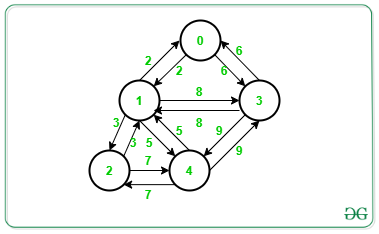
Input: graph[V][V] = {{0, 2, 0, 6, 0}, {2, 0, 3, 8, 5}, {0, 3, 0, 0, 7}, {6, 8, 0, 0, 9}, {0, 5, 7, 9, 0}}
👁 Image
Output:
The total weight of the Maximum Spanning tree is 30.
Edges Weight
3 - 1 8
4 - 2 7
0 - 3 6
3 - 4 9
Explanation:
Choosing other edges won't result in maximum spanning tree.
Maximum Spanning Tree:
Given an undirected weighted graph, a maximum spanning tree is a spanning tree having maximum weight. It can be easily computed using Prim’s algorithm. The goal here is to find the spanning tree with the maximum weight out of all possible spanning trees.
Prim’s Algorithm:
Prim’s algorithm is a greedy algorithm, which works on the idea that a spanning tree must have all its vertices connected. The algorithm works by building the tree one vertex at a time, from an arbitrary starting vertex, and adding the most expensive possible connection from the tree to another vertex, which will give us the Maximum Spanning Tree (MST).
Follow the steps below to solve the problem:
Below is the implementation of the above algorithm:
Weight of the maximum Spanning-tree 30

Edges Weight
3 - 1 8
4 - 2 7
0 - 3 6
3 - 4 9
Time Complexity: O(V2) where V is the number of nodes in the graph.
Auxiliary Space: O(V2)