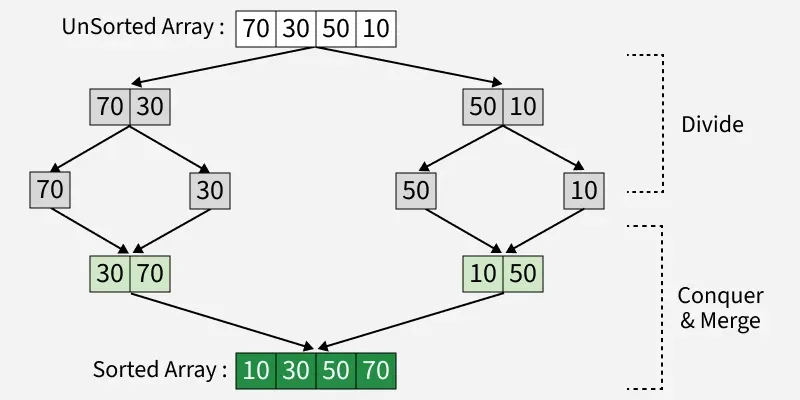
Merge sort is a popular sorting algorithm known for its efficiency and stability. It follows the Divide and Conquer approach. It works by recursively dividing the input array into two halves, recursively sorting the two halves and finally merging them back together to obtain the sorted array.
T(n) Represents the total time time taken by the algorithm to sort an array of size n.
2T(n/2) represents time taken by the algorithm to recursively sort the two halves of the array. Since each half has n/2 elements, we have two recursive calls with input size as (n/2).
O(n) represents the time taken to merge the two sorted halves
Complexity Analysis of Merge Sort
Time Complexity:
Best Case: O(n log n), When the array is already sorted or nearly sorted.
Average Case: O(n log n), When the array is randomly ordered.
Worst Case: O(n log n), When the array is sorted in reverse order.
Auxiliary Space: O(n), Additional space is required for the temporary array used during merging.
Applications of Merge Sort:
Sorting large datasets
External sorting (when the dataset is too large to fit in memory)
Merge Sort and its variations are used in library methods of programming languages. Its variation TimSort is used in Python, Java Android and Swift. The main reason why it is preferred to sort non-primitive types is stability which is not there in QuickSort. Arrays.sort in Java uses QuickSort while Collections.sort uses MergeSort.
It is a preferred algorithm for sorting Linked lists.
It can be easily parallelized as we can independently sort subarrays and then merge.
Stability : Merge sort is a stable sorting algorithm, which means it maintains the relative order of equal elements in the input array.
Guaranteed worst-case performance: Merge sort has a worst-case time complexity of O(N logN) , which means it performs well even on large datasets.
Simple to implement: The divide-and-conquer approach is straightforward.
Naturally Parallel : We independently merge subarrays that makes it suitable for parallel processing.
Disadvantages
Space complexity: Merge sort requires additional memory to store the merged sub-arrays during the sorting process.
Not in-place: Merge sort is not an in-place sorting algorithm, which means it requires additional memory to store the sorted data. This can be a disadvantage in applications where memory usage is a concern.
Merge Sort is Slower than QuickSort in general as QuickSort is more cache friendly because it works in-place.