|
VOOZH | about |
|
VOOZH | about |
Given coordinate of two points A(x1, y1) and B(x2, y2) such that x1 < x2 and y1 < y2. The task to find all the intermediate points required for drawing line AB on the computer screen of pixels. Note that every pixel has integer coordinates.
We have discussed below algorithms for this task.
In this post, Mid-Point Line drawing algorithm is discussed which is a different way to represent Bresenham's algorithm introduced in previous post.
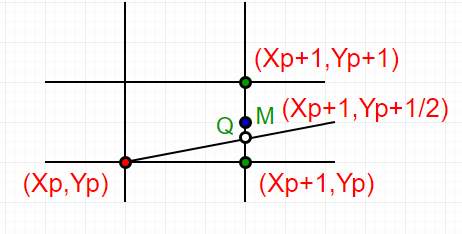
As discussed in previous post, for any given/calculated previous pixel P(Xp,Yp), there are two candidates for the next pixel closest to the line, E(Xp+1, Yp) and NE(Xp+1, Yp+1) (E stands for East and NE stands for North-East).
In Mid-Point algorithm we do following.
How to find if a point is above a line or below a line?
Below are some assumptions to keep algorithm simple.
Cases other than above assumptions can be handled using reflection.
Let us consider a line y = mx + B.
We can re-write the equation as :
y = (dy/dx)x + B or
(dy)x + B(dx) - y(dx) = 0
Let F(x, y) = (dy)x - y(dx) + B(dx) -----(1)
Let we are given two end points of a line (under
above assumptions)
-> For all points (x,y) on the line,
 the solution to F(x, y) is 0.
-> For all points (x,y) above the line,
 F(x, y) result in a negative number.
-> And for all points (x,y) below the line,
 F(x, y) result in a positive number.
This relationship is used to determine the relative
position of M
M = (Xp+1, Yp+1/2)
So our decision parameter d is,
d = F(M) = F(Xp+1, Yp+1/2)
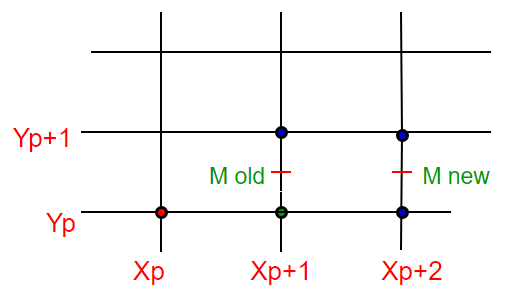
How to efficiently find new value of d from its old value?
For simplicity, let as write F(x, y) as ax + by + c.
Where a = dy
b = -dx
c = B*dx
We got these values from above equation (1)
Case 1: If E is chosen then for next point :
dnew = F(Xp+2, Yp+1/2)
= a(Xp+2) + b(Yp+1/2) + c
dold = a(Xp+1) + b(Yp+1/2) + c
Difference (Or delta) of two distances:
DELd = dnew - dold
= a(Xp+2)- a(Xp+1)+ b(Yp+1/2)- b(Yp+1/2)+ c-c
= a(Xp) +2a – a(Xp) - a
= a.
Therefore, dnew = dold + dy. (as a = dy)
Case 2: If NE is chosen then for next point :
dnew = F(Xp+2, Yp+3/2)
= a(Xp+2) + b(Yp+3/2) + c
dold = a(Xp+1) + b(Yp+1/2) + c
Difference (Or delta) of two distances:
DELd = dnew -dold
= a(Xp+2)- a(Xp+1)+ b(Yp+3/2)- b(Yp+1/2)+ c-c
= a(Xp) + 2a - a(Xp) - a + b(Yp) + 3/2b - b(Yp) -1/2b
= a + b
Therefore, dnew = dold + dy - dx. (as a = dy , b = -dx)
Calculation For initial value of decision parameter d0:
d0 = F(X1+1 , Y1+1/2)
= a(X1 + 1) + b(Y1 + 1/2) +c
= aX1+ bY1 + c + a + b/2
= F(X1,Y1) + a + b/2
= a + b/2 (as F(X1, Y1) = 0 )
d0 = dy - dx/2. (as a = dy, b = -dx)
Algorithm:
Input (X1,Y1) and (X2,Y2)
dy = Y2- Y1
dx = X2 - X1
// initial value of
// decision parameter d


if(dy<=dx){
d = dy - (dx/2)
x = X1 , y = Y1

// plot initial given point
Plot(x , y)

// iterate through value of X
while(x < X2)
 x = x+1

 // 'E' is chosen
 if (d < 0)
 d = d + dy

 // 'NE' is chosen
 else
 d = d + dy - dx
 y = y+1
 Plot(x,y)}

else if(dx<=dy)
{
d = dx - (dy/2)
x = X1 , y = Y1

// plot initial given point
Plot(x , y)

// iterate through value of X
while(y< Y2)
 y= y+1

 // 'E' is chosen
 if (d < 0)
 d = d + dx

 // 'NE' is chosen
 else
 d = d + dx - dy
 x= x+1
 Plot(x,y)
}
Below is the implementation of above idea:
Output:
2,2
3,3
4,3
5,4
6,4
7,5
8,5
Time Complexity: O(x2 - x1)
Auxiliary Space: O(1)
References:
https://my.eng.utah.edu/~cs5600/slides/Wk%202%20Lec02_Bresenham.pdf