Minimax Algorithm in Game Theory | Set 1 (Introduction)
Last Updated : 27 May, 2026
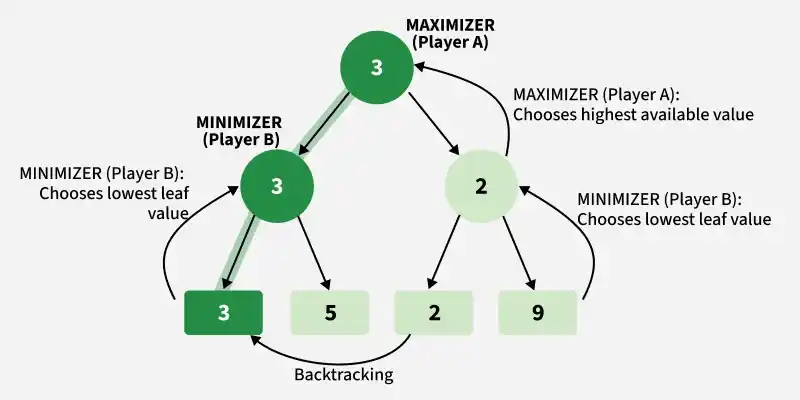
Minimax is a backtracking-based algorithm used in game theory and AI to determine the optimal move in competitive games by evaluating all possible future outcomes, assuming both players act optimally.
Works in two-player, turn-based, zero-sum games
Builds a decision process based on game states and outcomes
Widely used in strategic games like Tic-Tac-Toe and Chess
Key Concepts
Maximizer: Player who tries to maximize the final score or outcome
Minimizer: Player who tries to minimize the final score or opponent’s advantage
Game State: Representation of the current configuration of the game
Utility Value: Numerical score assigned to terminal states to represent win, loss, or draw outcomes
Game Tree: Tree structure representing all possible moves and resulting states
Heuristic Evaluation: Function used to estimate the value of non-terminal states when full exploration is not possible
Working
Constructs a game tree where nodes represent game states and edges represent possible moves
Expands all possible future moves up to terminal states or a depth limit
Assigns utility values to leaf nodes using game outcomes or heuristic evaluation
Propagates values upward: maximizer selects maximum value, minimizer selects minimum value
Final decision is made at the root node based on optimal play assumption by both players
Implementing the Minimax algorithm using a simple game tree where leaf nodes represent final scores, and the algorithm finds the optimal value assuming both players play optimally.
Step 1: Importing Required Module
Using the math module to compute the depth of the game tree.
Step 2: Defining Minimax Function
This function recursively evaluates the game tree and returns the optimal value based on maximizing and minimizing turns.
Step 3: Defining game states
We define leaf node values representing final game outcomes.
Step 4: Computing the tree depth
Calculating the depth of the binary game tree using logarithm.
Step 5: Run the Minimax algorithm
We start evaluation from the root node assuming the maximizer plays first.
Output:
The optimal value is: 12
Advantages
Guarantees optimal move selection under perfect play assumption
Works well for deterministic, turn-based, zero-sum games
Serves as the base for advanced techniques like Alpha-Beta Pruning
Suitable for problems with limited search space
Limitations
Exponential time complexity makes it inefficient for large game trees
Explores all possible moves regardless of usefulness
Not scalable for complex games without optimization
Requires high computational resources for deeper searches