|
VOOZH | about |
|
VOOZH | about |
Given a string S, the task is to print the string after removing the minimum size substring such that S is a palindrome or not.
Examples:
Input: S = "pqrstsuvwrqp"
Output: pqrstsrqp
Explanation:
Removal of the substring "uvw" modifies S to a palindromic string.Input: S = "geeksforskeeg"
Output: geeksfskeeg
Explanation:
Removal of substring "or" modifies S to a palindromic string.
Approach:
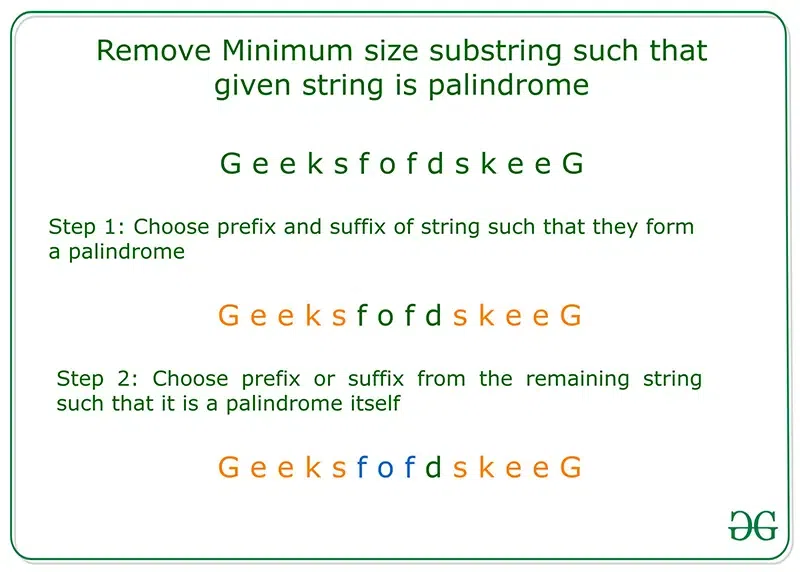
The idea is to include maximum size prefix and suffix from the given string S whose concatenation forms a palindrome. Then, choose the maximum length prefix or suffix from the remaining string which is a palindrome in itself.
Below is the illustration of the approach with the help of an image:
Below is the implementation of the above approach:
geeksfskeeg
Time Complexity: O(N2)
Auxiliary Space: O(N)
The idea is to choose the longest prefix and suffix such that they form a palindrome. After that from the remaining string we choose the longest prefix or suffix which is a palindrome. For computing the longest palindromic prefix(or suffix) we use Prefix Function which will take linear time to determine it.
Follow the steps to solve the above problem:
Below is the implementation of above approach:
geeksrskeeg
Time Complexity: O(N), where N is the length of the given string.
Auxiliary Space: O(N)