|
VOOZH | about |
|
VOOZH | about |
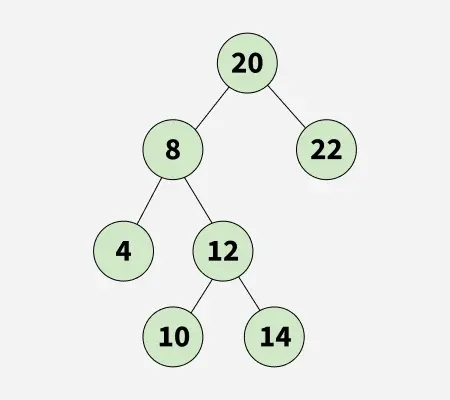
Given a generic tree and a integer x. Find and return the node with next larger element in the tree i.e. find a node just greater than x. Return NULL if no node is present with value greater than x.
For example, in the given tree, x = 10, just greater node value is 12
The idea is maintain a node pointer res, which will contain the final resultant node.
Traverse the tree and check if root data is greater than x. If so, then compare the root data with res data.
If root data is greater than n and less than res data update res.
Implementation:
Next larger element of 5 is 6
Time complexity :- O(N)
Space complexity :- O(H)
Traverse the tree in post-order and store the nodes in a stack.
Create an empty hash map to store the next larger element for each node.
For each node in the stack, pop it from the stack and find the next larger element for it by checking the elements on the top of the stack. If an element on the top of the stack is greater than the current node, it is the next larger element for the current node. Keep popping elements from the stack until the top of the stack is less than or equal to the current node.
Add the next larger element for the current node to the hash map.
Repeat steps 3 and 4 until the stack is empty.
Return the next larger element for the target node by looking it up in the hash map.
Note: This algorithm assumes that the tree is a binary search tree, where the value of each node is greater than the values of its left child and less than the values of its right child. If the tree is not a binary search tree, the above algorithm may not give correct result
The next larger element for 4 is 7The time complexity of this algorithm is O(n), where n is the number of nodes in the n-ary tree. The reason for this is that we traverse each node in the tree once, and for each node, we perform a constant amount of work to find its next larger element.
The auxiliary space of this algorithm is O(n), where n is the number of nodes in the n-ary tree. The reason for this is that we use a stack to store the nodes in post-order and a hash map to store the next larger element for each node. The size of the stack and the hash map is proportional to the number of nodes in the tree, so their combined space complexity is O(n).