|
VOOZH | about |
|
VOOZH | about |
Prerequisites: Graph Theory Basics, Spanning tree.
Complete Weighted Graph: A graph in which an edge connects each pair of graph vertices and each edge has a weight associated with it is known as a complete weighted graph.
The number of spanning trees for a complete weighted graph with n vertices is n(n-2).
Proof: Spanning tree is the subgraph of graph G that contains all the vertices of the graph. Therefore, the number of spanning trees of a complete weighted graph is the same as the number of labeled trees (need not be binary) with n vertices.
The Prüfer sequence of a labeled tree of n vertices is a unique sequence of length (n-2) associated with the tree. Also, for a given Prüfer sequence of length (n-2) on the labels 1 to n, there is a unique labeled tree with the given Prüfer sequence. Therefore, we have a bijection between the set A of labeled trees with n vertices and the set B of Prüfer sequences of size n-2 on the labels 1 to n. This can be proved as follows -
Let T be a labeled tree with vertices 1,2,...,n, and S as a Prüfer sequence of size (n-2). Thus, T and S are the elements of sets A and B, respectively.
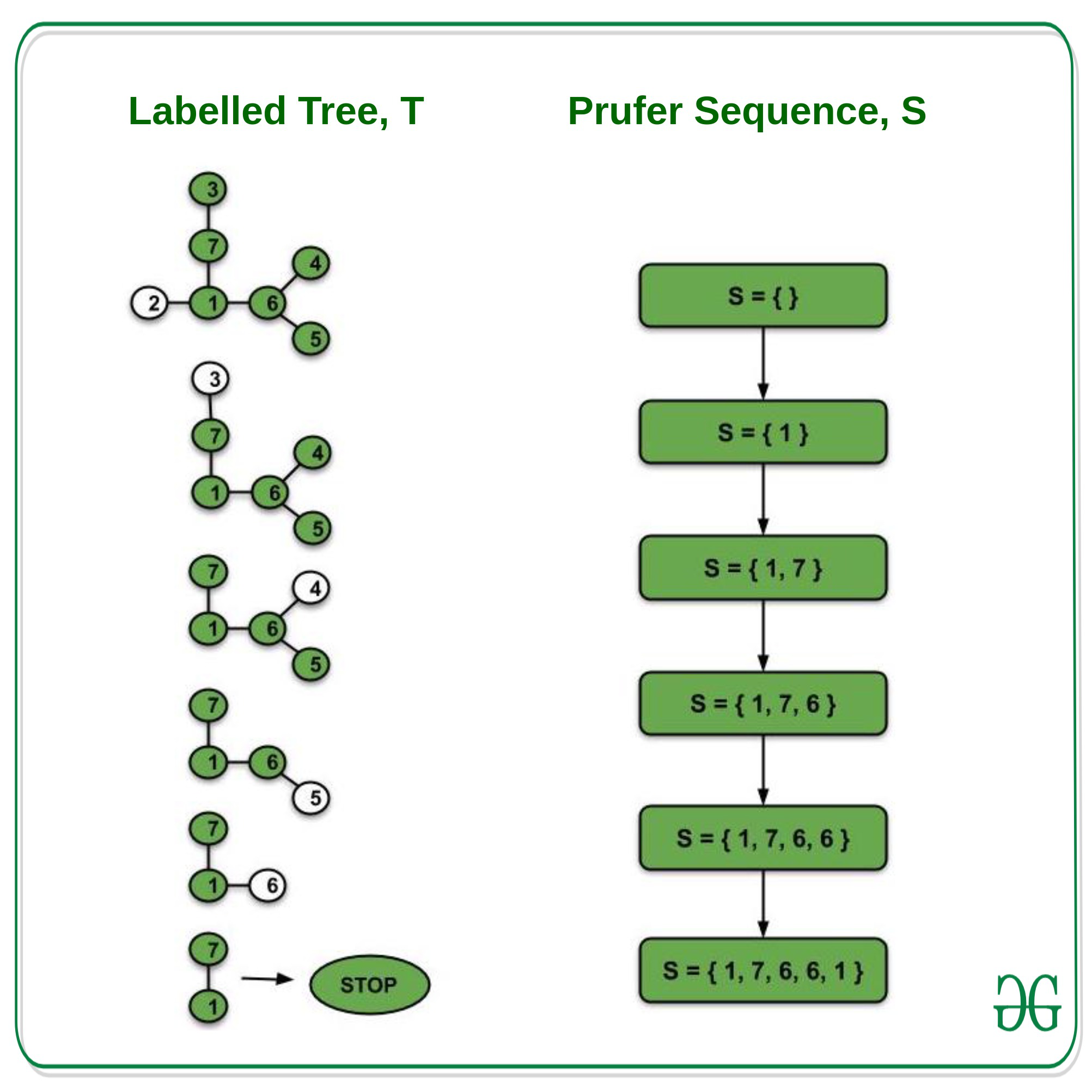
(i) Labeled tree (T) --> Prufer sequence (S)
-
Initially, let S = NULL.
Procedure -
Observations -
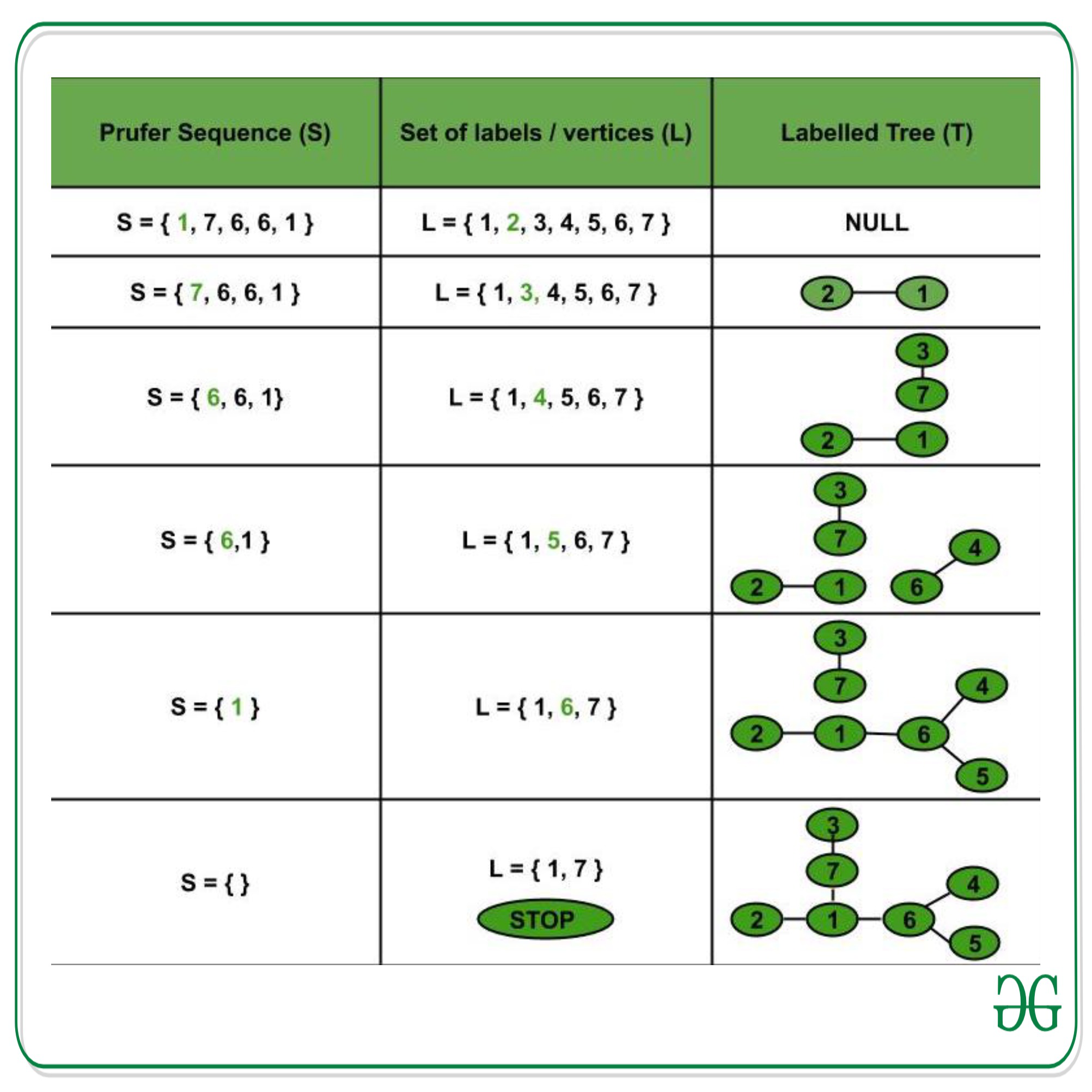
(ii) Prufer Sequence (S) --> Labeled Tree (T)
ü-
Procedure-
The tree obtained from S is the same as T. Therefore, Prüfer sequence S of size (n-2) is analogous to T ( S <--> T ). Hence, there is a bijection between the set of labeled trees with n vertices and the set of Prüfer sequences of size (n-2) on the labels 1 to n.
Thus, the number of spanning trees of a complete weighted graph of n vertices = number of labeled trees with n vertices = number of Prüfer sequences of size (n-2) = n(n-2).