|
VOOZH | about |
|
VOOZH | about |
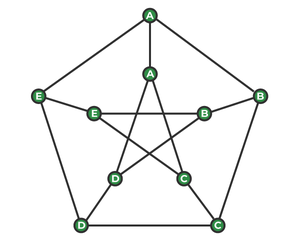
The following graph G is called a Petersen graph and its vertices have been numbered from 0 to 9. Some letters have also been assigned to vertices of G, as can be seen from the following picture:
Let's consider a walk W in graph G, which consists of L vertices W1, W2, ..., WL. A string S of L letters 'A' - 'E' is realized by walking W if the sequence of letters written along W is equal to S. Vertices can be visited multiple times while walking along W.
For example, S = 'ABBECCD' is realized by W = (0, 1, 6, 9, 7, 2, 3). Determine whether there is a walk W that realizes a given string S in graph G and if so then find the lexicographically least such walk. The only line of input contains one string S. If there is no walk W which realizes S, then output -1 otherwise, you should output the least lexicographical walk W which realizes S.
Examples:
Input : s = 'ABB'
Output: 016
Explanation: As we can see in the graph
 the path from ABB is 016.
Input : s = 'AABE'
Output :-1
Explanation: As there is no path that
 exists, hence output is -1.
Algorithm for a Peterson Graph Problem:
petersonGraphWalk(S, v):
begin
res := starting vertex
for each character c in S except the first one, do
if there is an edge between v and c in outer graph, then
v := c
else if there is an edge between v and c+5 in inner graph, then
v := c + 5
else
return false
end if
put v into res
done
return true
end
Below is the implementation of the above algorithm:
016
Time complexity: O(N)
The time complexity of the above program is O(N), where N is the length of the given string S. We are applying Breadth First Search here, which runs in linear time.
Space complexity: O(N)
The space complexity of the above program is O(N), where N is the length of the given string S. We are using two auxiliary arrays - result[] and S[] to store the path and the given string, respectively. Both of them require linear space.