|
VOOZH | about |
|
VOOZH | about |
Given an undirected Graph consisting of N nodes in the form of an adjacency matrix graph[][] of size N*N, the task is to print all Hamiltonian cycles possible in the given undirected Graph (taking starting vertex as '0').
A Hamiltonian cycle (or Hamiltonian circuit) is a Hamiltonian Path such that there is an edge (in the graph) from the last vertex to the first vertex of the Hamiltonian Path.
Examples:
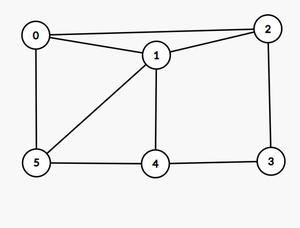
Input: graph[][] = {{0, 1, 1, 0, 0, 1}, {1, 0, 1, 0, 1, 1}, {1, 1, 0, 1, 0, 0}, {0, 0, 1, 0, 1, 0}, {0, 1, 0, 1, 0, 1}, {1, 1, 0, 0, 1, 0}}
👁 Image
Output:
0 1 2 3 4 5 0
0 1 5 4 3 2 0
0 2 3 4 1 5 0
0 2 3 4 5 1 0
0 5 1 4 3 2 0
0 5 4 3 2 1 0
Explanation:
All Possible Hamiltonian Cycles for the following graph (with the starting vertex as 0) are
- {0 ? 1 ? 2 ? 3 ? 4 ? 5 ? 0}
- {0 ? 1 ? 5 ? 4 ? 3 ? 2 ? 0}
- {0 ? 2 ? 3 ? 4 ? 1 ? 5 ? 0}
- {0 ? 2 ? 3 ? 4 ? 5 ? 1 ? 0}
- {0 ? 5 ? 1 ? 4 ? 3 ? 2 ? 0}
- {0 ? 5 ? 4 ? 3 ? 2 ? 1 ? 0}
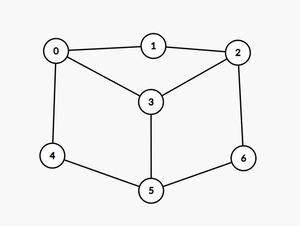
Input: graph[][] = {{0, 1, 0, 1, 1, 0, 0}, {1, 0, 1, 0, 0, 0, 0}, {0, 1, 0, 1, 0, 0, 1}, {1, 0, 1, 0, 0, 1, 0}, {1, 0, 0, 0, 0, 1, 0}, {0, 0, 0, 1, 1, 0, 1}, {0, 0, 1, 0, 0, 1, 0}}
👁 Image
Output: No Hamiltonian Cycle possible
Explanation:
For the given graph, no Hamiltonian Cycle is possible:
Approach: The given problem can be solved by using Backtracking to generate all possible Hamiltonian Cycles. Follow the steps below to solve the problem:
Below is the implementation of the above approach:
0 1 2 3 4 5 0 0 1 5 4 3 2 0 0 2 3 4 1 5 0 0 2 3 4 5 1 0 0 5 1 4 3 2 0 0 5 4 3 2 1 0
Time Complexity: O(N!)
Auxiliary Space: O(N)