|
VOOZH | about |
|
VOOZH | about |
Given a vectors of vectors arr[], the task is to print the elements of arr[] in the diagonally upwards order as illustrated below.
Examples:
Input: arr[][] = {{1, 2, 3}, {4, 5, 6}, {7, 8, 9}}
👁 Image
Output: 1 4 2 7 5 3 8 6 9
Explanation:
Below is the illustration of how diagonally upward order is printed:
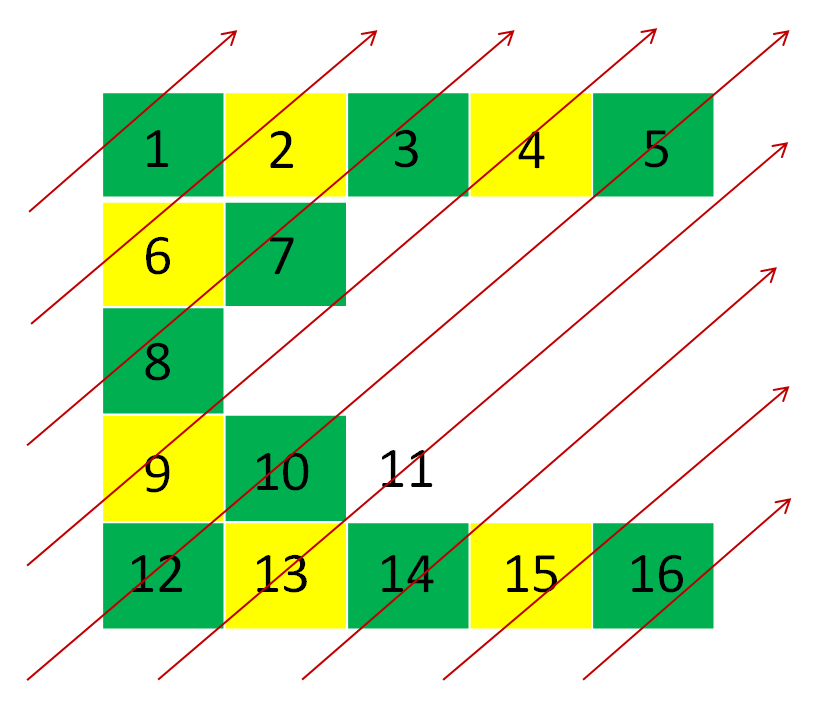
Input: arr[][] = {{1, 2, 3, 4, 5}, {6, 7}, {8}, {9, 10, 11}, {12, 13, 14, 15, 16}}
👁 Image
Output: 1 6 28 7 3 9 4 12 10 5 13 11 14 15 16
Explanation:
Below is the illustration of how diagonally upward order is printed:
Approach: The idea is based on the observation that all elements in a particular upward diagonal have a sum equal to the (row index + column index). Follow the steps to solve the problem:
Below is the implementation of the above approach:
1 4 2 7 5 3 8 6 9
Time Complexity: O(N*M), where N is the size of the given matrix and M is maximum size of any row in the matrix.
Auxiliary Space: O(N*M)
Alternate Approach: The above problem can be also be solved by using queue. Follow the steps to solve the problem:
Below is the implementation of the above approach:
1 4 2 7 5 3 8 6 9
Time Complexity: O(N*M), where N is the size of the given matrix and M is maximum size of any row in the matrix.
Auxiliary Space: O(N)