|
VOOZH | about |
|
VOOZH | about |
Given weights and values of n items, put these items in a knapsack of capacity W to get the maximum total value in the knapsack. In other words, given two integer arrays, val[0..n-1] and wt[0..n-1] represent values and weights associated with n items respectively. Also given an integer W which represents knapsack capacity, find out the items such that sum of the weights of those items of a given subset is smaller than or equal to W. You cannot break an item, either pick the complete item or don’t pick it (0-1 property).
Prerequisite : 0/1 Knapsack
Examples :
Input : val[] = {60, 100, 120};
 wt[] = {10, 20, 30};
 W = 50;
Output : 220 //maximum value that can be obtained
 30 20 //weights 20 and 30 are included.

Input : val[] = {40, 100, 50, 60};
 wt[] = {20, 10, 40, 30};
 W = 60;
Output : 200
 30 20 10
Approach :
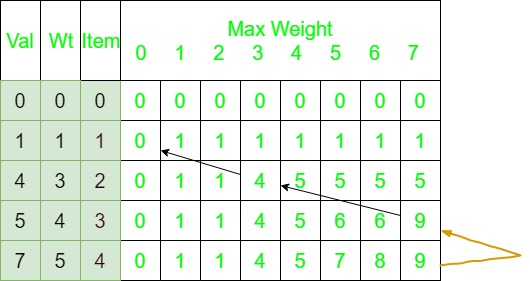
Let val[] = {1, 4, 5, 7}, wt[] = {1, 3, 4, 5}
W = 7.
The 2d knapsack table will look like :
Start backtracking from K[n][W].Here K[n][W] is 9.
Since this value comes from the top (shown by grey arrow), the item in this row is not included. Go vertically upward in the table without including this in the knapsack. Now, this value K[n-1][W] which is 9 doesn't come from the top which means the item in this row is included and go vertically up and then left by the weight of the included item ( shown by black arrow). Continuing this process include weights 3 and 4 with a total value 9 in the knapsack.
220
30 20
Time complexity: O(n*W)
Space complexity: O(n*W)