|
VOOZH | about |
|
VOOZH | about |
International Mobile Equipment Identity (IMEI) is a number, usually unique, to identify mobile phones, as well as some satellite phones. It is usually found printed inside the battery compartment of the phone, but can also be displayed on-screen on most phones by entering *#06# on the dialpad, or alongside other system information in the settings menu on smartphone operating systems. The IMEI number is used by a GSM network to identify valid devices and therefore can be used for stopping a stolen phone from accessing that network.
The IMEI (15 decimal digits: 14 digits plus a check digit) includes information on the origin, model, and serial number of the device.
The IMEI is validated in following steps:
- Starting from the rightmost digit, double the value of every second digit (e.g., 7 becomes 14).
- If doubling of a number results in a two digits number i.e greater than 9(e.g., 7 × 2 = 14), then add the digits of the product (e.g., 14: 1 + 4 = 5), to get a single digit number.
- Now take the sum of all the digits.
- Check if the sum is divisible by 10 i.e.(total modulo 10 is equal to 0) then the IMEI number is valid; else it is not valid.
Example:
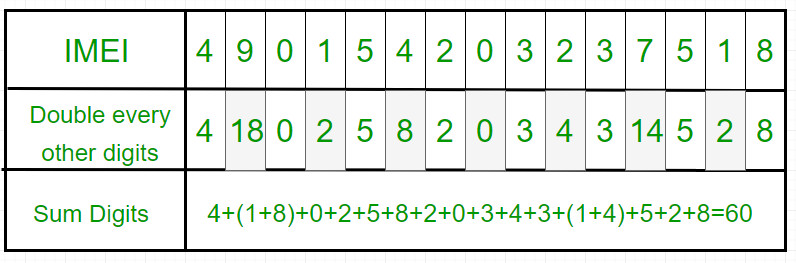
Input IMEI : 490154203237518
Output : Since, 60 is divisible by 10, hence the given IMEI number is Valid.
Implementation:
Valid IMEI Code
Time complexity : O(n log10 n)
Auxiliary Space: O(n)