Program for Next Fit algorithm in Memory Management
Last Updated : 25 Oct, 2025
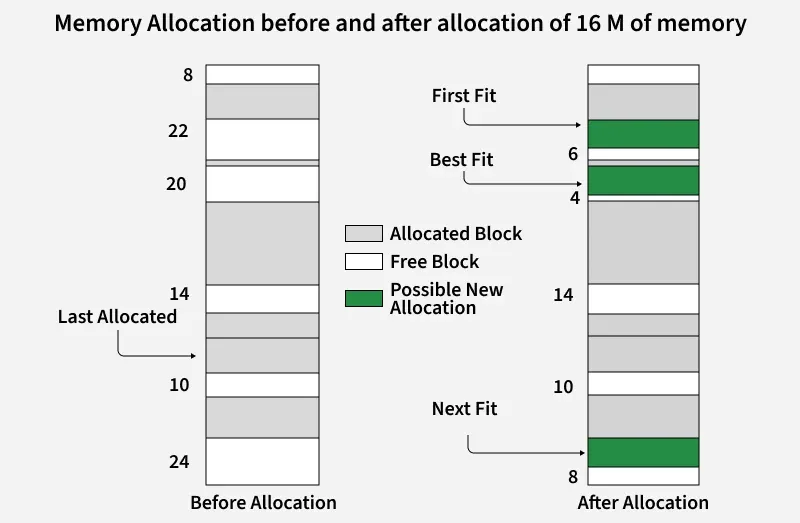
The Next Fit algorithm is a modified version of the First Fit memory allocation technique. While the First Fit algorithm always starts searching from the beginning of the memory block list for each new process, the Next Fit algorithm optimizes this behavior by continuing the search from where it last left off.
Note: This is achieved by maintaining a roving pointer, which remembers the position of the last allocated block and begins the next search from there instead of restarting from the beginning.
Advantages of Next Fit over First Fit
Reduces fragmentation near the beginning: Unlike First Fit, which continuously fills the initial part of memory, Next Fit distributes allocations more evenly across the memory space.
Improved performance: Since it doesn’t restart the search every time, the average time to find a free block is reduced, making it faster than First Fit and Best Fit in many scenarios.
Better load balancing: Memory usage gets spread more uniformly, reducing the chances of creating too many small fragments in a specific region.
Example
Input:
Block sizes: [5, 10, 20] Process sizes: [10, 20, 30]
Output:
Process No. Process Size Block No. 1 10 2 2 20 3 3 30 Not Allocated
Algorithm Steps
Input the number and size of memory blocks.
Mark all blocks as free.
Input the number and size of processes.
For each process: Check if it can be allocated in the current block.
If yes, allocate and move the pointer to the current block.
If not, continue checking further blocks in a circular fashion.