|
VOOZH | about |
|
VOOZH | about |
Kite is something like rhombus but in Kite, the adjacent sides are equal and diagonals are generally not equal.
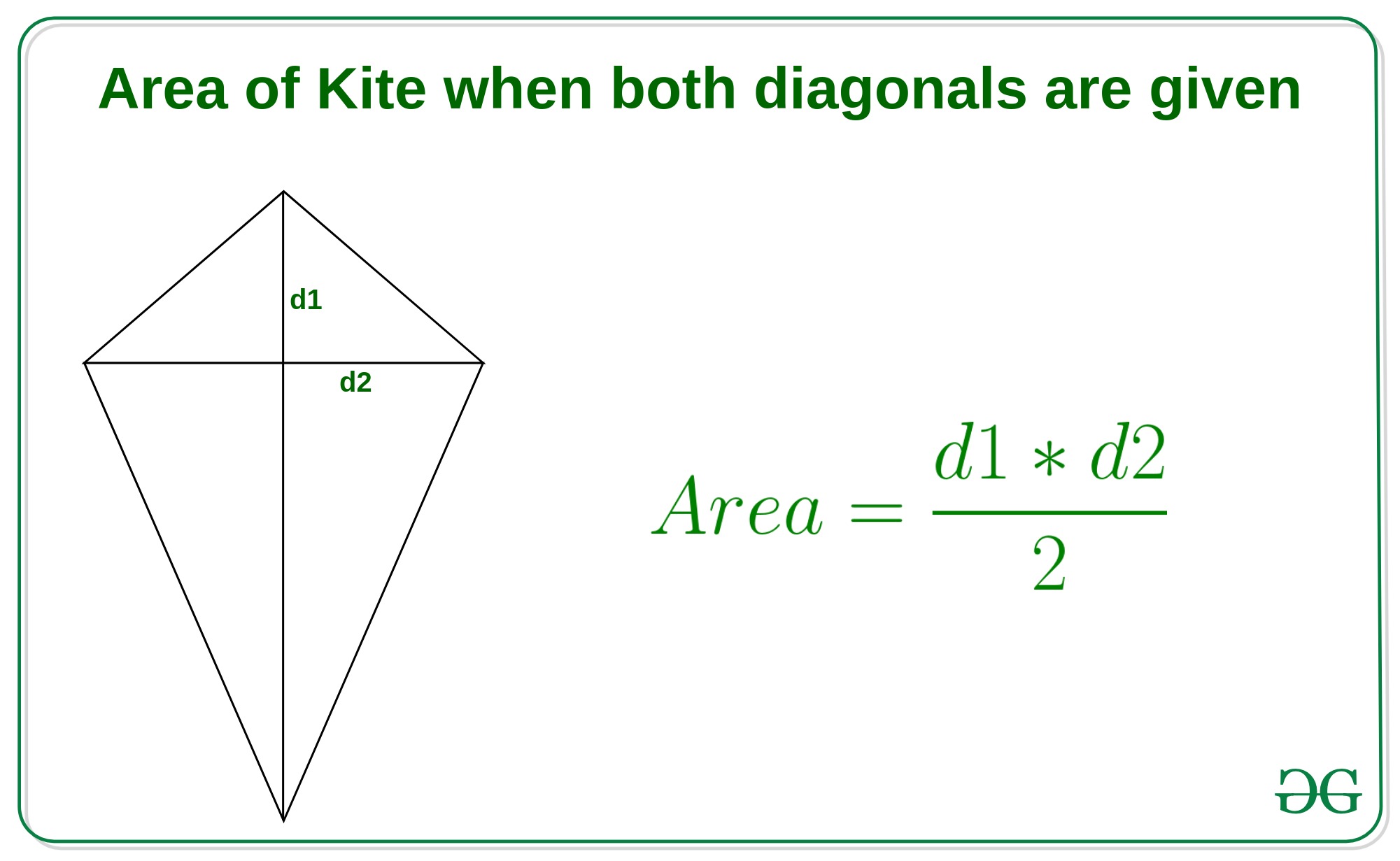
Method 1: When both the diagonals are given
👁 Image
If diagonals d1 and d2 are given of the kite, then the area of a kite is half of product of both the diagonals i.e.
Example:
Input: d1 = 4, d2 = 6
Output: Area of Kite = 12

Input: d1 = 5, d2 = 7
Output: Area of Kite = 17.5
Approach: In this method we simply use above formula.
Below is the implementation of the above approach:
Area of Kite = 12
Time Complexity: O(1)
Auxiliary Space: O(1)
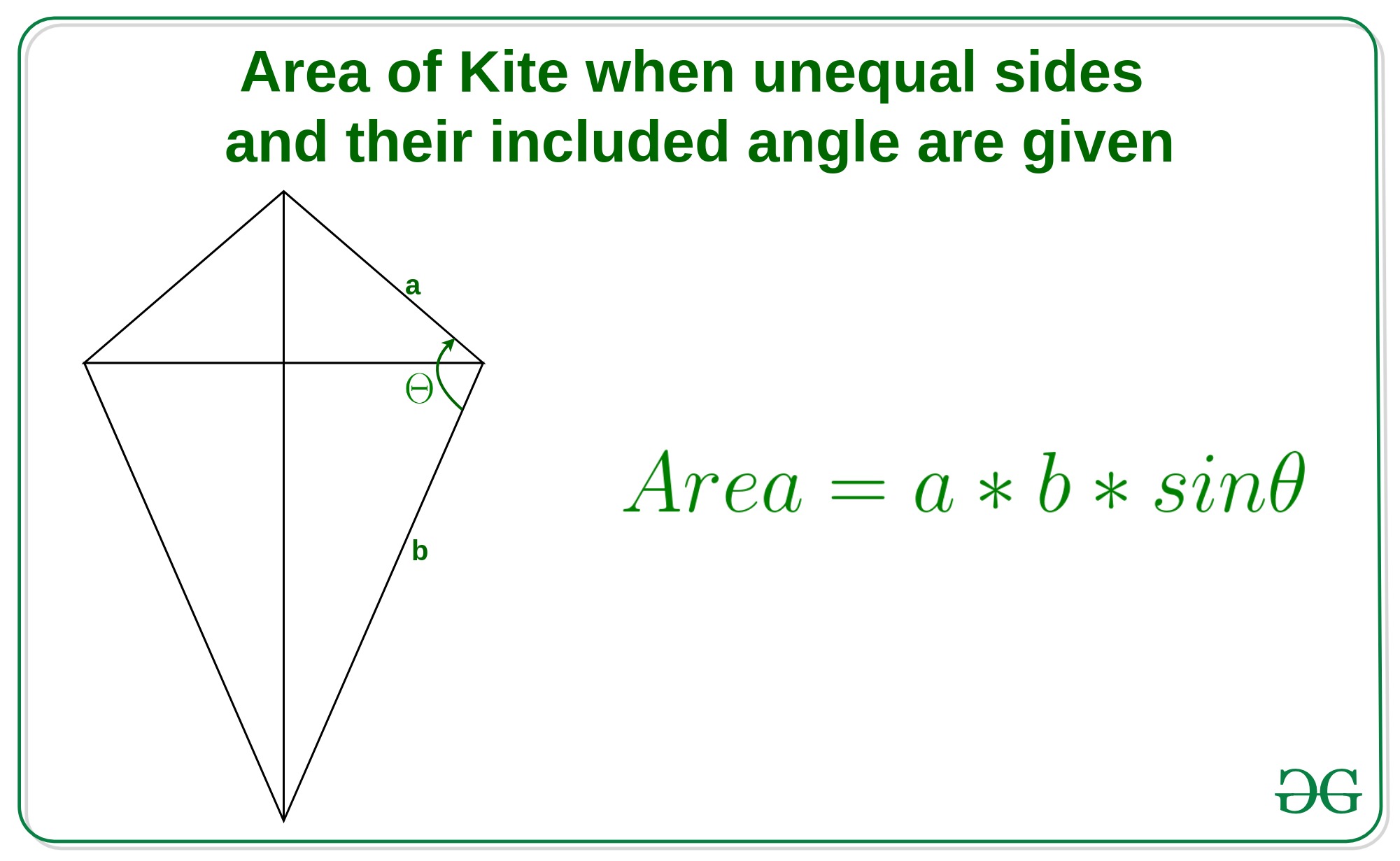
Method 2: When side a, b and angle are given:
👁 Image
When the unequal sides of kite a and b and the included angle Θ between them are given, then
Example:
Input: a = 4, b = 7, θ = 78
Output: Area of Kite = 27.3881

Input: a = 6, b = 9, θ = 83
Output: Area of Kite = 53.5975
Approach: In this method we simply use above formula.
Below is the implementation of the above approach:
Area of Kite = 27.3881
Time Complexity: O(1)
Auxiliary Space: O(1)