|
VOOZH | about |
|
VOOZH | about |
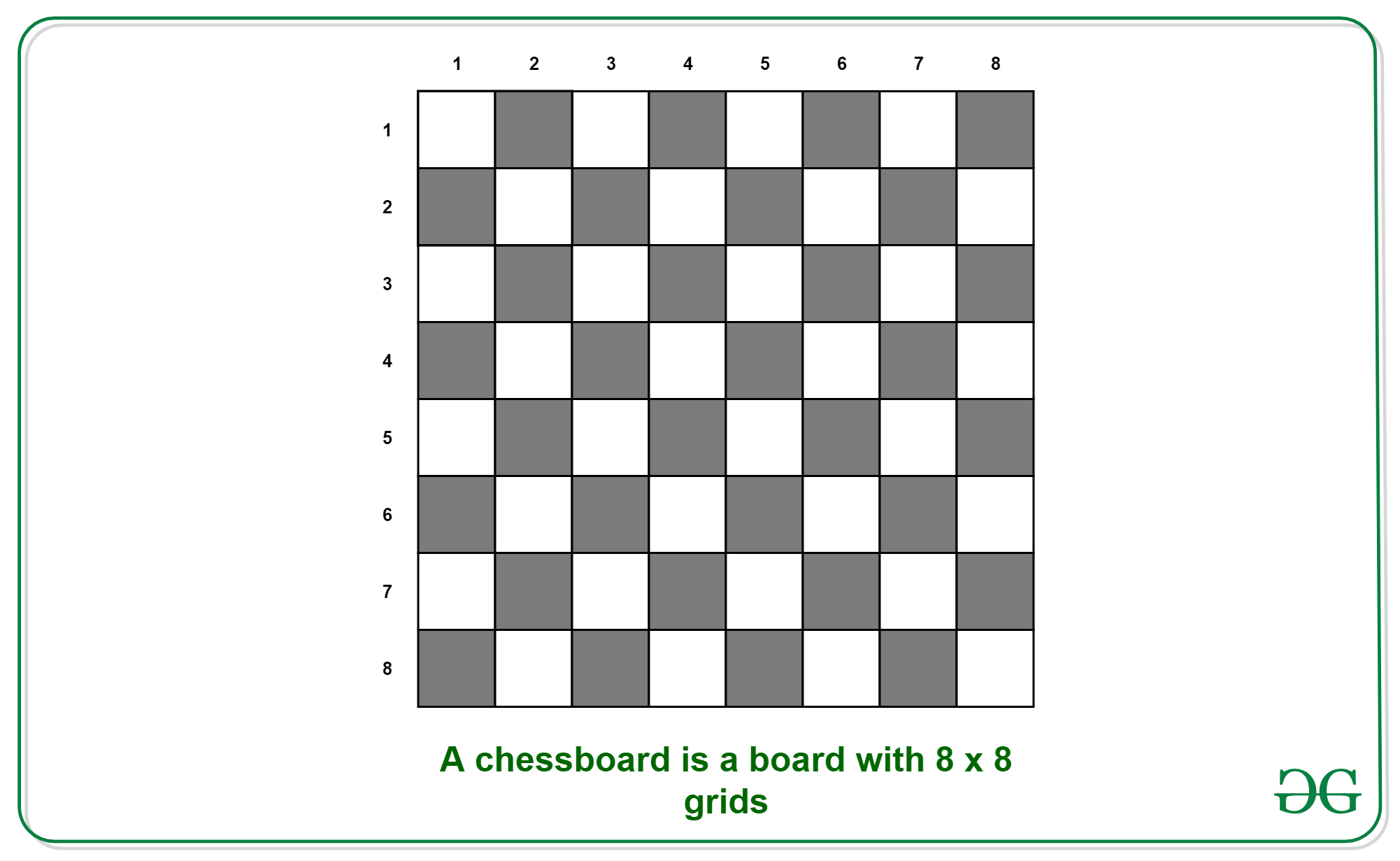
You are provided with a chessboard and are asked to find the total number of squares in it. A chessboard is a board with 8 x 8 grids in it, as represented below.
Examples:
Input: n = 2
Output: 5 (4 squares of 1 unit + 1 square of 2 units)
Explanation: Total number of square = 5 (4 squares with side of 1 unit + 1 square with side of 2 units)Input: n = 3
Output: 14
Explanation: Total number of square = 14 ( 9 squares with side of 1 unit , 4 square with side of 2 units, 1 square with side of 3 units )
Looking closely at the chessboard we can see that in addition to the 1 x 1 square, there can be a combination of 2 x 2, 3 x 3, 4 x 4, 5 x 5, 6 x 6, 7 x 7, and 8 x 8 squares too. To get the total number of squares we need to find all the squares formed.
No of 1 x 1 Square : 8 * 8 = 64 squares.
No of 2 x 2 Square : 7 * 7 = 49 squares.
No of 3 x 3 Square : 6 * 6 = 36 squares.
No of 4 x 4 Square : 5 * 5 = 25 squares.
No of 5 x 5 Square : 4 * 4 = 16 squares.
No of 6 x 6 Square : 3 * 3 = 9 squares.
No of 7 x 7 Square : 2 * 2 = 4 squares.
No of 8 x 8 Square : 1 * 1 = 1 square.
Therefore, we have in all = 64 + 49 + 36 + 25 + 16 + 9 + 4 + 1 = 204 squares in a chessboard.
By using the above observation the total number of squares formed in a grid of size n*n are:
1^2 + 2^2 + 3^2 + ... + n^2 = n(n+1)(2n+1) / 6
Since the value of n*(n+1)*(2n+1) can cause overflow for large values of n, below are some interesting tricks used in the program.
30
Time Complexity: O(1)
Auxiliary Space: O(1)