|
VOOZH | about |
|
VOOZH | about |
Given four points, check whether they form Pythagorean Quadruple.
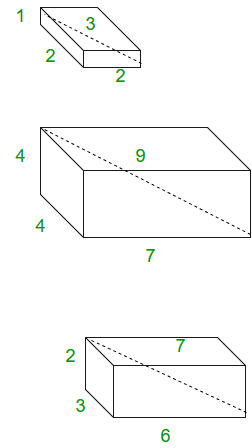
It is defined as a tuple of integers a, b, c, d such that . They are basically the solutions of Diophantine Equations. In the geometric interpretation it represents a cuboid with integer side lengths |a|, |b|, |c| and whose space diagonal is |d| .
The cuboids sides shown here are examples of pythagorean quadruples.
It is primitive when their greatest common divisor is 1. Every Pythagorean quadruple is an integer multiple of a primitive quadruple. We can generate the set of primitive pythagorean quadruples for which a is odd can be generated by formula :
a = m2 + n2 - p2 - q2,
b = 2(mq + np),
c = 2(nq - mp),
d = m2 + n2 + p2 + q2
where m, n, p, q are non-negative integers with greatest common divisor 1 such that m + n + p + q are odd. Thus, all primitive Pythagorean quadruples are characterized by Lebesgue's identity.
(m2 + n2 + p2 + q2)2 = (2mq + 2nq)2 + 2(nq - mp)2 + (m2 + n2 - p2 - q2)m2 + n2 - p2 - q2
Output:
Yes
Time Complexity: O(1)
Auxiliary Space: O(1)