|
VOOZH | about |
|
VOOZH | about |
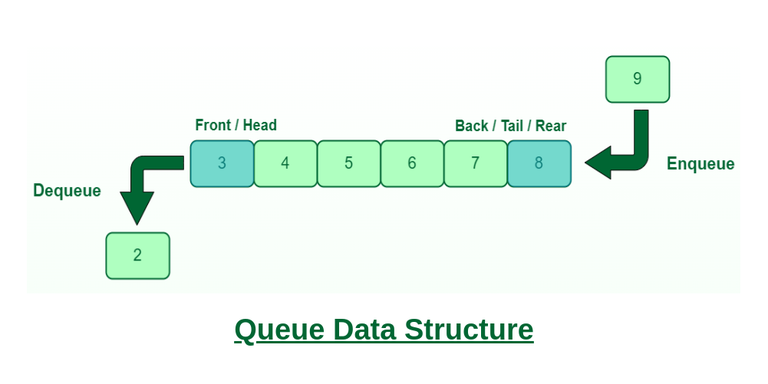
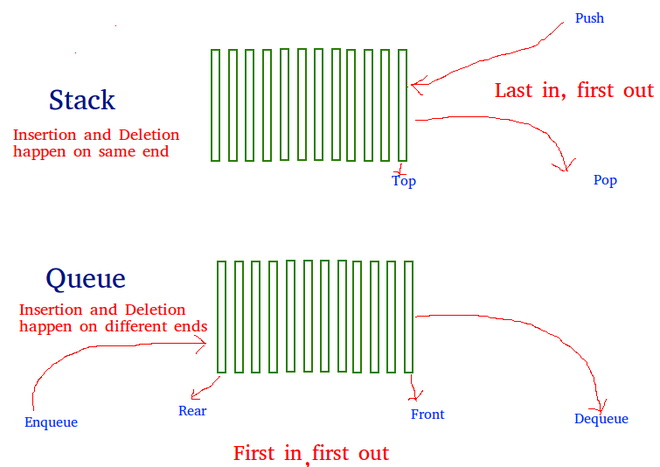
AQueueis defined as a linear data structure that is open at both ends and the operations are performed in First In First Out (FIFO) order. Queue is a list in which all additions to the list are made at one end, and all deletions from the list are made at the other end. The element, which is first pushed into the order, the operation is first performed on that.
Table of Content
To implement a queue using an array,
Now, some of the implementations of queue operations are as follows:
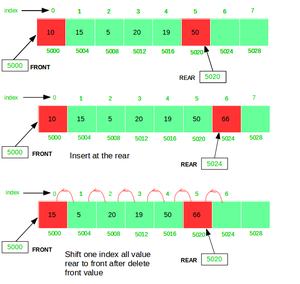
- Enqueue: Addition of an element to the queue. Adding an element will be performed after checking whether the queue is full or not. If rear < n which indicates that the array is not full then store the element at arr[rear] and increment rear by 1 but if rear == n then it is said to be an Overflow condition as the array is full. Enqueue has O(1) time complexity.
- Dequeue: Removal of an element from the queue. An element can only be deleted when there is at least an element to delete i.e. rear > 0. Now, the element at arr[front] can be deleted but all the remaining elements have to shift to the left by one position in order for the dequeue operation to delete the second element from the left on another dequeue operation. Dequeue has O(N) time complexity.
- Front: Get the front element from the queue i.e. arr[front] if the queue is not empty. Accessing the front of the queue has O(1) time complexity.
- Display: Print all elements of the queue. If the queue is non-empty, traverse and print all the elements from the index front to rear. Displaying all the elements has O(N) time complexity.
- Overall Space Complexity: O(N)
To implement a queue using a Linked List,
Now, some of the implementations of queue operations are as follows:
- Create a class QNode with data members integer data and QNode* next (pointer to the next node)
- Create a class Queue with data members QNode front and rear
- Enqueue Operation with parameter x:
- Initialize QNode* temp with data = x
- If the rear is set to NULL then set the front and rear to temp and return (Base Case)
- Else set rear next to temp and then move rear to temp
- Enqueue has O(1) time complexity.
- Dequeue Operation:
- If the front is set to NULL return (Base Case)
- Initialize QNode temp with front and set front to its next
- If the front is equal to NULL then set the rear to NULL
- Delete temp from the memory.
- Dequeue has O(1) time complexity.
- Overall Space Complexity: O(N)
A queue can be implemented using two stacks. Let queue to be implemented be q and stacks used to implement q be stack1 and stack2. q can be implemented in three ways:
This method makes sure that oldest entered element is always at the top of stack 1, so that deQueue operation just pops from stack1. To put the element at top of stack1, stack2 is used.
enQueue(q, x):
deQueue(q):
In this method, in en-queue operation, the new element is entered at the top of stack1. In de-queue operation, if stack2 is empty then all the elements are moved to stack2 and finally top of stack2 is returned.
enQueue(q, x):
deQueue(q):
Method 2 is definitely better than method 1. Method 1 moves all the elements twice in enQueue operation, while method 2 (in deQueue operation) moves the elements once and moves elements only if stack2 empty. So, the amortized complexity of the dequeue operation becomes Θ(1)
Method 2 can be modified where recursion (or Function Call Stack) is used to implement queue using only one user defined stack.
enQueue(x):
deQueue():
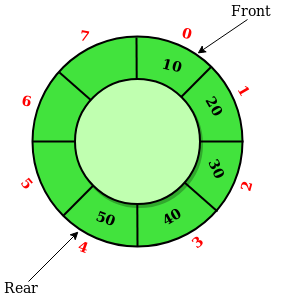
A Circular Queue is an extended version of a normal queue where the last element of the queue is connected to the first element of the queue forming a circle. The operations are performed based on FIFO (First In First Out) principle. It is also called ‘Ring Buffer’.
Operations on Circular Queue:
Applications of Circular Queue:
A priority queue is a type of queue that arranges elements based on their priority values. Elements with higher priority values are typically retrieved before elements with lower priority values.
If we add an element with a high priority value to a priority queue, it may be inserted near the front of the queue, while an element with a low priority value may be inserted near the back.
Types of Priority Queue:
Properties of Priority Queue:
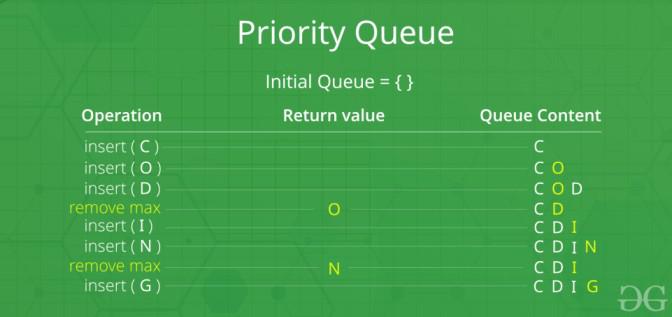
In the below priority queue, an element with a maximum ASCII value will have the highest priority. The elements with higher priority are served first.
Operations on Priority Queue:
Applications of Priority Queue:
Deque or Double Ended Queue is a generalized version of Queue data structure that allows insert and delete at both ends.
Operations on Double Ended Queue:
Applications of Double Ended Queue:
Q1. Following is C like pseudo-code of a function that takes a Queue as an argument, and uses a stack S to do processing.
What does the above function do in general?
(A) Removes the last from Q
(B) Keeps the Q same as it was before the call
(C) Makes Q empty
(D) Reverses the Q
Answer: (D)
Explanation: The function takes a queue Q as an argument. It dequeues all items of Q and pushes them to a stack S. Then pops all items of S and enqueues the items back to Q. Since the stack is LIFO order, all items of the queue are reversed.
Hence option (D) is the correct answer.
Q2. Which one of the following is an application of Queue Data Structure?
(A) When a resource is shared among multiple consumers.
(B) When data is transferred asynchronously (data not necessarily received at same rate as sent) between two processes
(C) Load Balancing
(D) All of the above
Answer: (D)
Explanation:
(A) When a resource is shared among multiple consumers: In scenarios where a resource (such as a printer, CPU time, or database connection) needs to be shared among multiple consumers or processes, a queue data structure can be used. Each consumer can enqueue their requests for the resource, and the resource can be allocated to them in the order of their requests by dequeuing from the queue. This ensures fair access to the shared resource and prevents conflicts or resource contention.(B) When data is transferred asynchronously between two processes: When data is transferred asynchronously between two processes or systems, a queue can be used as a buffer or intermediary storage. One process enqueues the data to be sent, while the other process dequeues and processes the received data. The queue allows for decoupling the rate of data production from data consumption, ensuring smooth and efficient communication between the processes.
(C) Load Balancing: Load balancing is the practice of distributing workloads across multiple resources to optimize performance and utilization. A queue data structure can be used in load-balancing algorithms to manage incoming requests or tasks. The requests are enqueued in the queue, and the load balancer can dequeue and assign them to available resources based on various criteria (e.g., round-robin, least connections). This helps distribute the workload evenly across the resources, preventing overload and maximizing throughput.
Q3. How many stacks are needed to implement a queue. Consider the situation where no other data structure like arrays, linked list is available to you.
(A) 1
(B) 2
(C) 3
(D) 4
Answer: (B)
Explanation: A queue can be implemented using two stacks. Refer this for more reference: https://www.geeksforgeeks.org/dsa/queue-using-stacks/
Hence Option(B) is the correct answer.
Q4. How many queues are needed to implement a stack. Consider the situation where no other data structure like arrays, linked list is available to you.
(A) 1
(B) 2
(C) 3
(D) 4
Answer: (B)
Explanation: A stack can be implemented using two queues. Refer this for more reference: https://www.geeksforgeeks.org/dsa/implement-stack-using-queue/
Hence Option(B) is the correct answer.
Q5. Which of the following is true about linked list implementation of queue?
(A) In push operation, if new nodes are inserted at the beginning of linked list, then in pop operation, nodes must be removed from end.
(B) In push operation, if new nodes are inserted at the end, then in pop operation, nodes must be removed from the beginning.
(C) Both of the above
(D) None of the above
Answer: (C)
Explanation: To keep the First In First Out order, a queue can be implemented using a linked list in any of the given two ways.
Hence option (C) is the correct answer.
Q6. Suppose a circular queue of capacity (n – 1) elements is implemented with an array of n elements. Assume that the insertion and deletion operation are carried out using REAR and FRONT as array index variables, respectively. Initially, REAR = FRONT = 0. The conditions to detect queue full and queue empty are
(A) Full: (REAR+1) mod n == FRONT, empty: REAR == FRONT
(B) Full: (REAR+1) mod n == FRONT, empty: (FRONT+1) mod n == REAR
(C) Full: REAR == FRONT, empty: (REAR+1) mod n == FRONT
(D) Full: (FRONT+1) mod n == REAR, empty: REAR == FRONT
Answer: (A)
Explanation: Suppose we start filling the queue.
Let the maxQueueSize ( Capacity of the Queue) is 4.So the size of the array which is used to implement this circular queue is 5, which is n. In the beginning when the queue is empty, FRONT and REAR point to 0 index in the array. REAR represents insertion at the REAR index. FRONT represents deletion from the FRONT index.
enqueue("a"); REAR = (REAR+1)%5; ( FRONT = 0, REAR = 1)
enqueue("b"); REAR = (REAR+1)%5; ( FRONT = 0, REAR = 2)
enqueue("c"); REAR = (REAR+1)%5; ( FRONT = 0, REAR = 3)
enqueue("d"); REAR = (REAR+1)%5; ( FRONT = 0, REAR = 4)
Now the queue size is 4 which is equal to the maxQueueSize. Hence overflow condition is reached.
Now, we can check for the conditions.
When Queue Full :
( REAR+1)%n = (4+1)%5 = 0
FRONT is also 0. Hence ( REAR + 1 ) %n is equal to FRONT.
When Queue Empty :
REAR was equal to FRONT when empty ( because in the starting before filling the queue FRONT = REAR = 0 )
Hence Option A is correct.
Q7. Consider the following pseudo code. Assume that IntQueue is an integer queue. What does the function fun do?
(A) Prints numbers from 0 to n-1
(B) Prints numbers from n-1 to 0
(C) Prints first n Fibonacci numbers
(D) Prints first n Fibonacci numbers in reverse order.
Answer: (C)
Explanation: The function prints first n Fibonacci Numbers. Note that 0 and 1 are initially there in q. In every iteration of the loop sum of the two queue items is enqueued and the front item is dequeued.
Hence option (C) is the correct answer.
Q8. Which of the following is NOT a common operation in a queue data structure?
(A) Enqueue
(B) Dequeue
(C) Peak
(D) Shuffle
Answer: (D)
Explanation: Shuffle is NOT a common operation in a queue data structure.
Hence Option (D) is the correct answer.
Q9. Suppose a stack implementation supports an instruction REVERSE, which reverses the order of elements on the stack, in addition to the PUSH and POP instructions. Which one of the following statements is TRUE with respect to this modified stack?
(A) A queue cannot be implemented using this stack.
(B) A queue can be implemented where ENQUEUE takes a single instruction and DEQUEUE takes a sequence of two instructions.
(C) A queue can be implemented where ENQUEUE takes a sequence of three instructions and DEQUEUE takes a single instruction.
(D) A queue can be implemented where both ENQUEUE and DEQUEUE take a single instruction each.
Answer: (C)
Explanation: To DEQUEUE an item, simply POP. To ENQUEUE an item, we can do following 3 operations 1) REVERSE 2) PUSH 3) REVERSE
Hence Option (C) is the correct answer.
Q10. A queue is implemented using an array such that ENQUEUE and DEQUEUE operations are performed efficiently. Which one of the following statements is CORRECT (n refers to the number of items in the queue)?
(A) Both operations can be performed in O(1) time
(B) At most one operation can be performed in O(1) time but the worst case time for the other operation will be Ω(n)
(C) The worst case time complexity for both operations will be Ω(n)
(D) Worst case time complexity for both operations will be Ω(log n)
Answer: (A)
Explanation: We can use circular array to implement both in O(1) time. See below article for details
Queue Introduction and Array Implementation
Hence Option (D) is the correct answer.