|
VOOZH | about |
|
VOOZH | about |
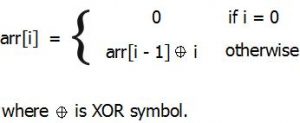
Consider an arr[] which can be defined as:
You are given Q queries of the form [l, r]. The task is to output the value of arr[l] ? arr[l+1] ? ..... ? arr[r-1] ? arr[r] for each query.
Examples :
Input : q = 3
 q1 = { 2, 4 }
 q2 = { 2, 8 }
 q3 = { 5, 9 }
Output : 7
 9
 15

The beginning of the array with constraint look like:
arr[] = { 0, 1, 3, 0, 4, 1, 7, 0, 8, 1, 11, .... }
For q1, 3 ? 0 ? 4 = 7
For q2, 3 ? 0 ? 4 ? 1 ? 7 ? 0 ? 8 = 9
For q3, 1 ? 7 ? 0 ? 8 ? 1 = 15
Let's observe arr[]
arr[0] = 0
arr[1] = 1
arr[2] = 1 ? 2
arr[3] = 1 ? 2 ? 3
arr[4] = 1 ? 2 ? 3 ? 4
arr[5] = 1 ? 2 ? 3 ? 4 ? 5
....
Let's make another array, say brr[], where brr[i] = arr[0] ? arr[1] ? arr[2] ? ..... ? arr[i].
brr[i] = arr[0] ? arr[1] ? arr[2] ? ... ? arr[i-1] ? arr[i] = brr[j] ? arr[j+1] ? arr[j+2] ? ..... ? arr[i], for any 0 <= j <= i.
So, arr[l] ? arr[l+1] ? ..... ? arr[r] = brr[l-1] ? brr[r].
Now, let's observe brr[]:
brr[1] = 1
brr[2] = 2
brr[3] = 1 ? 3
brr[4] = 2 ? 4
brr[5] = 1 ? 3 ? 5
brr[6] = 2 ? 4 ? 6
brr[7] = 1 ? 3 ? 5 ? 7
brr[8] = 2 ? 4 ? 6 ? 8
It's easy to observe that in odd indexes brr[i] = 1 ? 3 ? 5 ? .... ? i and for even indexes brr[i] = 2 ? 4 ? 6 ? .... ? i.
For even indexes there are numbers from 1 to i/2 multipliedby 2, that means bits are moved to left by 1, so, brr[i] = 2 ? 4 ? 6 ? .... ? i = (1 ? 2 ? 3 ? ..... ? i/2) * 2.
And for odd indexes there are numbers from 0 to (i - 1)/2 multiplied by 2 and plus 1. That means bits are moved to left by 1, and last bit is made 1. So, brr[i] = 1 ? 3 ? 5 ? .... ? i = (0 ? 1 ? 2 ? .... ? (i - 1)/2) * 2 + x.
x is 1 ? 1 ? 1 ? ..... ? 1 "ones" are repeated (i - 1)/2 + 1 times. So, if (i-1)/2 + 1 is odd then x = 1 else x = 0.
Now, calculation of 1 ? 2 ? 3 ? .... ? x.
Let's prove that (4K) ? (4K + 1) ? (4K + 2) ? (4K + 3) = 0 for 0 <= k.
 bitmask(K)00=4K
 xorsum bitmask(K)01=4K+1
 bitmask(K)10=4K+2
 bitmask(K)11=4k+3
 ---------------------
 000000000000=0
So as 0 ? Y = Y then 1 ? 2 ? 3 ? ... ? x = (floor(x/4) x 4) ? ... ? x here are maximum 3 numbers so we can calculate in O(1).
Below is the implementation of this approach:
0
2
0
Time Complexity: O(q* log(n)) where q is the number of queries and n is the largest value of r in the queries.
Auxiliary Space: O(1)