|
VOOZH | about |
|
VOOZH | about |
Given an array, rearrange the array such that :
Note: There can be multiple answers.
Examples:
Input : arr[] = {2, 3, 4, 5}
Output : arr[] = {2, 4, 3, 5}
Explanation : Elements at even indexes are
smaller and elements at odd indexes are greater
than their next elements

Note : Another valid answer
is arr[] = {3, 4, 2, 5}

Input :arr[] = {6, 4, 2, 1, 8, 3}
Output :arr[] = {4, 6, 1, 8, 2, 3}
This problem is similar to sorting an array in the waveform.
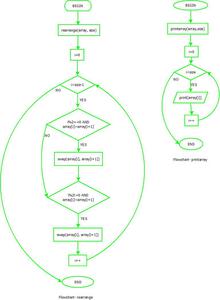
If we have an array of length n, then we iterate from index 0 to n-2 and check the given condition.
At any point of time if i is even and arr[i] > arr[i+1], then we swap arr[i] and arr[i+1]. Similarly, if i is odd and
arr[i] < arr[i+1], then we swap arr[i] and arr[i+1].
For the given example:
Before rearrange, arr[] = {2, 3, 4, 5}
Start iterating over the array till index 2 (as n = 4)
First Step:
At i = 0, arr[i] = 2 and arr[i+1] = 3. As i is even and arr[i] < arr[i+1], don't need to swap.
Second step:
At i = 1, arr[i] = 3 and arr[i+1] = 4. As i is odd and arr[i] < arr[i+1], swap them.
Now arr[] = {2, 4, 3, 5}
Third step:
At i = 2, arr[i] = 3 and arr[i+1] = 5. So, don't need to swap them
After rearrange, arr[] = {2, 4, 3, 5}
Flowchart
Implementation:
Before rearranging:
6 4 2 1 8 3
After rearranging:
4 6 1 8 2 3
Time Complexity: O(N), as we are using a loop to traverse N times,
Auxiliary Space: O(1), as we are not using any extra space.
The "Sort and Swap Adjacent Elements" approach for rearranging an array such that even index elements are smaller and odd index elements are greater can be summarized in the following steps:
Here are the detailed steps with an example:
Input: arr = [2, 3, 4, 5]
[2, 4, 3, 5]
The time complexity of the "Sort and Swap Adjacent Elements" approach for rearranging an array such that even index elements are smaller and odd index elements are greater is O(n log n),
The auxiliary space of this approach is O(1).