|
VOOZH | about |
|
VOOZH | about |
Binary Tree is a hierarchical data structure in which each node has at most two children, referred to as the left child and the right child. It is commonly used in computer science for efficient storage and retrieval of data, with various operations such as insertion, deletion, and traversal.
Prerequisite - Binary Tree Data Structure
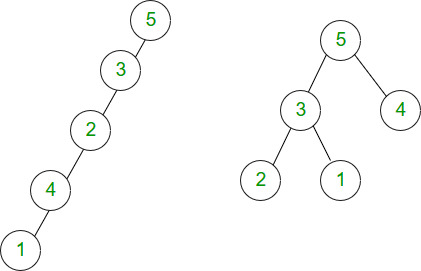
The height of the binary tree is the longest path from root node to any leaf node in the tree. For example, the height of binary tree shown in Figure 1(b) is 2 as longest path from root node to node 2 is 2. Also, the height of binary tree shown in Figure 1(a) is 4.
If there are n nodes in a binary tree, the maximum height of the binary tree is n-1, and the minimum height is floor (log2(n)).
For example, the left skewed binary tree shown in Figure 1(a) with 5 nodes has a height of 5-1 = 4, and the binary tree shown in Figure 1(b) with 5 nodes has a height floor(log25) = 2.
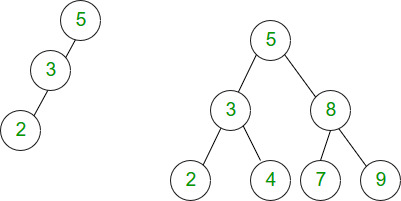
If binary tree has height h, minimum number of nodes is h+1 (in case of left skewed and right skewed binary tree). For example, the binary tree shown in Figure 2(a) with height 2 has 3 nodes.
If binary tree has height h, maximum number of nodes will be when all levels are completely full. Total number of nodes will be 2^0 + 2^1 + …. 2^h = 2^(h+1)-1. For example, the binary tree shown in Figure 2(b) with height 2 has 2^(2+1)-1 = 7 nodes.
Question-1.The height of a tree is the length of the longest root-to-leaf path in it. The maximum and the minimum number of nodes in a binary tree of height 5 are:
Solution:
According to formula discussed,
max number of nodes = 2^(h+1)-1 = 2^6-1 =63.
min number of nodes = h+1 = 5+1 = 6.
Question-2.Which of the following height is not possible for a binary tree with 50 nodes?
Solution:
According to formula discussed,
Minimum height with 50 nodes = floor(log2(50)) = 5. Therefore, height 4 is not possible.