|
VOOZH | about |
|
VOOZH | about |
Reverse Delete algorithm is closely related to Kruskal's algorithm. In Kruskal's algorithm what we do is : Sort edges by increasing order of their weights. After sorting, we one by one pick edges in increasing order. We include current picked edge if by including this in spanning tree not form any cycle until there are V-1 edges in spanning tree, where V = number of vertices.
In Reverse Delete algorithm, we sort all edges in decreasing order of their weights. After sorting, we one by one pick edges in decreasing order. We include current picked edge if excluding current edge causes disconnection in current graph. The main idea is delete edge if its deletion does not lead to disconnection of graph.
The Algorithm :
- Sort all edges of graph in non-increasing order of edge weights.
- Initialize MST as original graph and remove extra edges using step 3.
- Pick highest weight edge from remaining edges and check if deleting the edge disconnects the graph or not.
If disconnects, then we don't delete the edge.
Else we delete the edge and continue.
Illustration:
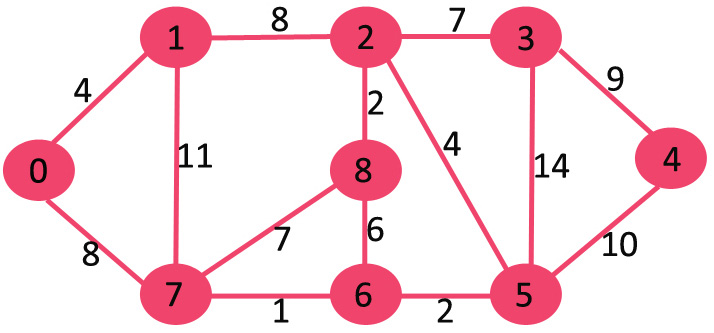
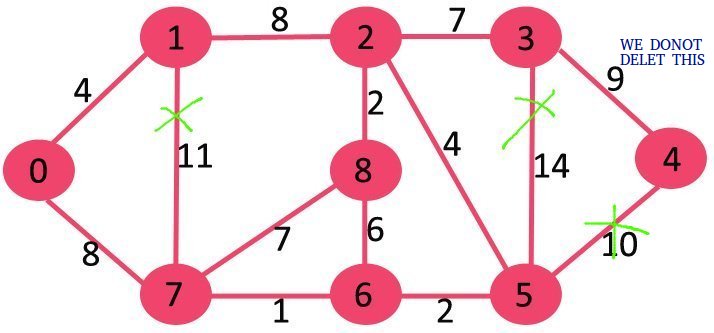
Let us understand with the following example:
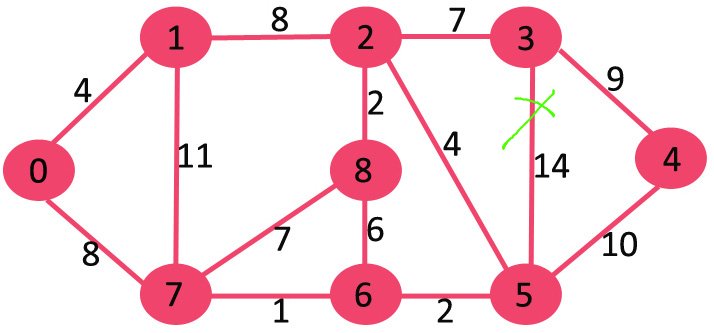
If we delete highest weight edge of weight 14, graph doesn't become disconnected, so we remove it.
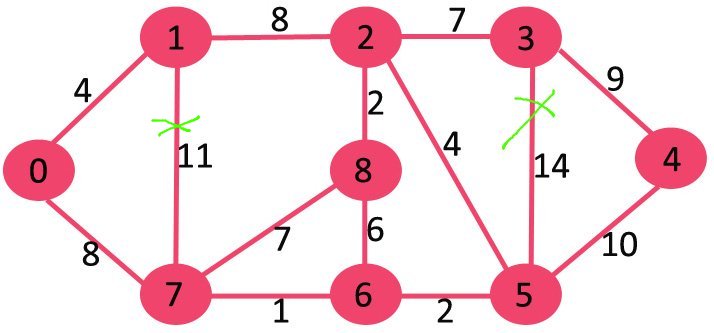
Next we delete 11 as deleting it doesn't disconnect the graph.
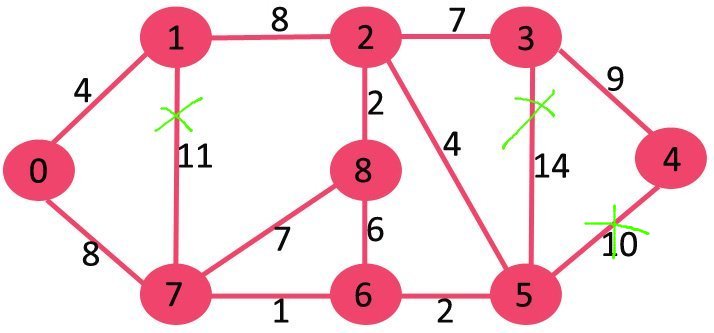
Next we delete 10 as deleting it doesn't disconnect the graph.
Next is 9. We cannot delete 9 as deleting it causes disconnection.
We continue this way and following edges remain in final MST.
Edges in MST
(3, 4)
(0, 7)
(2, 3)
(2, 5)
(0, 1)
(5, 6)
(2, 8)
(6, 7)
Note : In case of same weight edges, we can pick any edge of the same weight edges.
Implementation:
Edges in MST
(3, 4)
(0, 7)
(2, 3)
(2, 5)
(0, 1)
(5, 6)
(2, 8)
(6, 7)
Total weight of MST is 37
Time complexity: O((E*(V+E)) + E log E) where E is the number of edges.
Space complexity: O(V+E) where V is the number of vertices and E is the number of edges. We are using adjacency list to store the graph, so we need space proportional to O(V+E).
Notes :