|
VOOZH | about |
|
VOOZH | about |
We have already discussed the rotation of a point P about the origin in the Set 1 and Set 2. The rotation of point P about origin with an angle ? in the anti-clockwise direction is given as under:
Rotation of P about origin: P * polar(1.0, ?)
Rotation of P about point Q
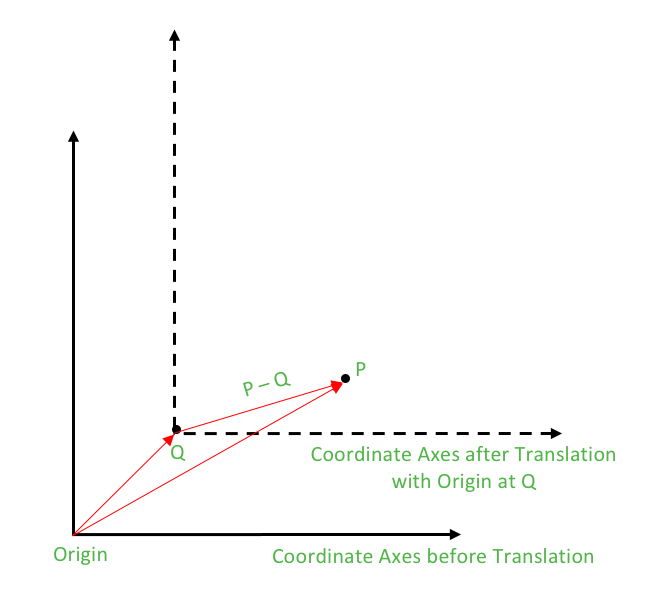
Now, we have to rotate the point P not about origin but about a general point Q. This can be easily understood by the method of translation which is quite a common technique adopted in geometric analysis. What is Translation? In Euclidean geometry, translation is a geometric transformation that moves every point of a figure or a space by the same amount in a given direction. How to Perform Translation? Translation can also be interpreted as the addition of a constant vector to every point, or as shifting the origin of the coordinate system. After the translation, required computations are made and the translation is nullified by subtracting the constant vector to every point or shifting the origin back. 👁 Translation of Coordinate Axes
So, for rotating P about Q, we shift the origin at Q i.e. we subtract the vector equivalent of Q from every point of the coordinate plane. Now the new point P – Q has to be rotated about the origin and then translation has to be nullified. These steps can be described as under:
Thus,
Rotation of P about Q : (P – Q) * polar(1.0, ?) + Q
Output:
The point P on rotating 90 degrees anti-clockwise about Q becomes: P_rotated(1, 4)
Time Complexity: O(1)
Auxiliary Space: O(1)
To rotate a point about another point in a two-dimensional coordinate system, you can follow these steps:
Identify the coordinates: Let's assume you have two points: the point you want to rotate (let's call it P), with coordinates (Px, Py), and the point about which you want to rotate (let's call it Q), with coordinates (Qx, Qy).
It's worth noting that the rotation angle ? is usually specified in radians. If you have an angle in degrees, you can convert it to radians by multiplying it by (?/180). Additionally, keep in mind that the direction of rotation (clockwise or counterclockwise) depends on the coordinate system and the sign convention used for the angles.