In this article, we will discuss various scheduling algorithms for Greedy Algorithms. Many scheduling problems can be solved using greedy algorithms.
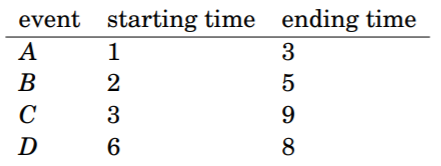
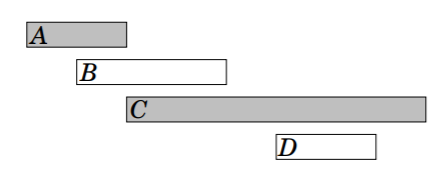
Problem statement: Given N events with their starting and ending times, find a schedule that includes as many events as possible. It is not possible to select an event partially. Consider the below events:
👁 Image
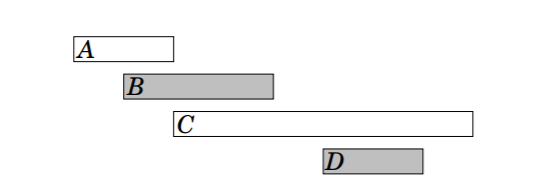
- In this case, the maximum number of events is two. As selected events B and D are as follows:
👁 Image
- It is possible to invent several greedy algorithms for the problem.
Algorithms that work with every case:
:
- The first idea is to select as short events as possible. In the example, this algorithm selects the following events:
👁 Image
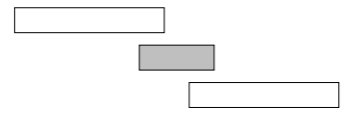
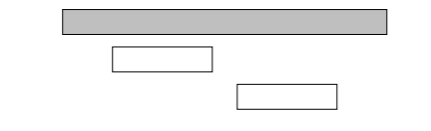
- However, selecting short events is not always a correct strategy. For example, the algorithm fails in the below case:
👁 Image
- If short event is selected, it can only select one event. However, it would be possible to select both long events.
:
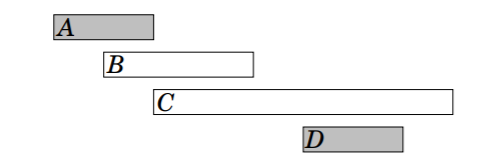
- Another idea is to always select the next possible event that begins as early as possible. This algorithm selects the following events:
👁 Image
- However, given a counter example for this algorithm. In this case, the algorithm only selects one event:
👁 Image
- If the first event is selected, it is not possible to select any other events. However, it would be possible to select the other two events.
:
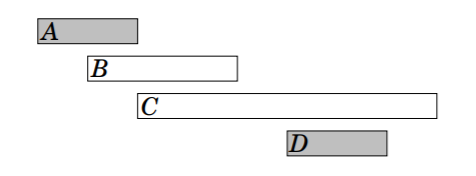
- The third idea is to always select the next possible event that ends as early as possible. This algorithm selects the following events:
👁 Image
- It turns out that this algorithm always produces an optimal solution.
- The reason for this is that it is always an optimal choice to first select an event that ends as early as possible.
- After this, it is an optimal choice to select the next event using the same strategy, etc., until any other event can't be selected.
- One way the algorithm works is to consider what happens if first select an event that ends later than the event that ends as early as possible.
- Now, with having at most an equal number of choices how the next event can be selected.
- Hence, selecting an event that ends later can never yield a better solution, and the greedy algorithm is correct.