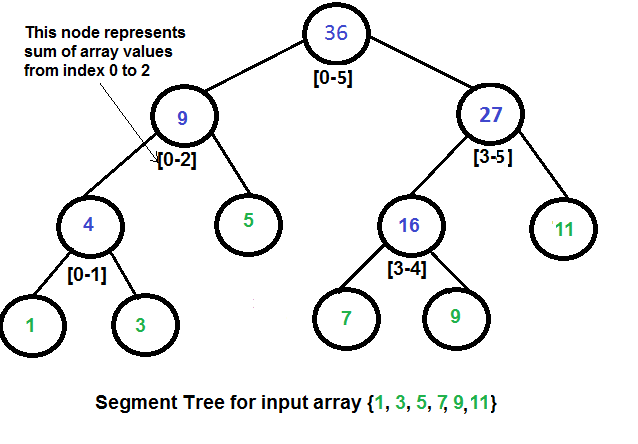
Let us consider the following problem to understand Segment Trees.
We have an array arr[0 . . . n-1]. We should be able to
- Find the sum of elements from index l to r where 0 <= l <= r <= n-1
- Change the value of a specified element of the array to a new value x. We need to do arr[i] = x where 0 <= i <= n-1.
A simple solution is to run a loop from l to r and calculate the sum of elements in the given range. To update a value, simply do arr[i] = x. The first operation takes O(n) time and the second operation takes O(1) time.
Another solution is to create another array and store the sum from start to i ,at the ith index in this array. The sum of a given range can now be calculated in O(1) time, but update operation takes O(n) time now. This works well if the number of query operations is large and very few updates.
The most efficient way is to use a segment tree, we can use a Segment Tree to do both operations in O(log(N)) time.
- Leaf Nodes are the elements of the input array.
- Each internal node represents some merging of the leaf nodes. The merging may be different for different problems. For this problem, merging is sum of leaf nodes under a node.
- An array representation of tree is used to represent Segment Trees. For each node at index i, the left child is at index (2*i+1), right child at (2*i+2) and the parent is at (⌊(i - 1) / 2⌋).
👁 Image
We start with a segment arr[0 . . . n-1]. and every time we divide the current segment into two (if it has not yet become a segment of length 1), and then call the same procedure on both halves, and for each such segment, we store the sum in the corresponding node.
All levels of the constructed segment tree will be completely filled except the last level. Also, the tree will be a Full Binary Tree because we always divide segment in two, at every level. Since the constructed tree is always a full binary tree with n leaves, there will be n-1 internal nodes. So the total number of nodes will be 2*n - 1.
Height of the segment tree will be ⌈log₂N⌉. Since the tree is represented using array and relation between parent and child indexes must be maintained, size of memory allocated for segment tree will be (2 * 2⌈log2n⌉ - 1).
Once the tree is constructed, how to get the sum using the constructed segment tree. The following is the algorithm to get the sum of elements.
int getSum(node, l, r)
{
 if the range of the node is within l and r
 return value in the node
 else if the range of the node is completely outside l and r
 return 0
 else
 return getSum(node's left child, l, r) +
 getSum(node's right child, l, r)
}
In the above implementation, there are three cases we need to take into consideration
- If the range of the current node while traversing the tree is not in the given range then did not add the value of that node in ans
- If the range of node is partially overlapped with the given range then move either left or right according to the overlapping
- If the range is completely overlapped by the given range then add it to the ans
Like tree construction and query operations, the update can also be done recursively. We are given an index which needs to be updated. Let diff be the value to be added. We start from the root of the segment tree and add diff to all nodes which have given index in their range. If a node doesn't have a given index in its range, we don't make any changes to that node.
The algorithmic steps to implement a segment tree are:
- Initialize the segment tree with a size equal to 4 * n, where n is the number of elements in the array.
- In the buildTree function, the base case is when the left and right bounds of the current segment are equal. In this case, the value of the current node in the segment tree is set to the value of the corresponding element in the array.
- For the rest of the cases, calculate the midpoint of the current segment and recursively call the buildTree function for the left and right subsegments.
- In the query function, the base case is when the current segment is completely contained within the query range. In this case, the value of the current node in the segment tree is returned.
- For the rest of the cases, calculate the midpoint of the current segment and recursively call the query function for the left and right subsegments. The minimum (or maximum, or sum, etc.) of the values returned from the left and right subsegments is returned.
- The query function can be called with the left and right bounds of the desired range to get the desired result.
Note: The implementation details, such as the type of aggregation and the way the midpoint is calculated, can vary based on the specific use case.
OutputSum of values in given range = 15
Updated sum of values in given range = 22
Time complexity: O(N*log(N))
Auxiliary Space: O(N)
Benifits of segment tree usage:
- Range Queries: One of the main use cases of segment trees is to perform range queries on an array in an efficient manner. The query function in the segment tree can return the minimum, maximum, sum, or any other aggregation of elements within a specified range in the array in O(log n) time.
- Dynamic Updates: Another advantage of using segment trees is that they support dynamic updates to the array. This means that elements in the array can be changed and the segment tree can be updated accordingly in O(log n) time.
- Space Optimization: Segment trees are space-optimized compared to other data structures such as the binary indexed tree. The space complexity of a segment tree is O(4n) in the worst case, which is better than the O(2n) space complexity of binary indexed trees.
- Versatility: Segment trees can be used to solve various range-based problems, such as finding the sum of elements within a range, finding the minimum/maximum element within a range, and finding the number of distinct elements within a range.
- Easy to Code: Segment trees are relatively easy to code compared to other data structures, and their implementation is straightforward, especially for range minimum/maximum queries.
Segment Tree | Set 2 (Range Minimum Query)