Bit manipulation is the technique of performing operations directly on the binary representation of integers. Since computers store data in binary form (0 or 1 ), bitwise operations are extremely fast and memory-efficient. The technique is widely used to perform binary operations efficiently, such as checking whether a number is odd or even, testing if a number is a power of two etc.
Common Bitwise Operators : I. Bitwise And Operator ( &) Sets each bit to 1 if both bits are 1 . Some common uses are to check if a number is even or odd, ith bit is set or not etc. Example - 5 & 3 → (00101) 2 & (00011) 2 → (00001) 2 → 1
II. Bitwise OR Operator ( | ) Sets each bit to 1 if at least one bits are 1. It is mainly used to set specific bits without affecting the others. Example - 5 | 3 → (00101) 2 | (00011) 2 → (00111) 2 → 7
III. Bitwise XOR Operator ( ^ ) Sets a bit to 1 if the corresponding bits are different. It is widely used for finding unique elements, swapping two numbers without extra space etc. Example - 5 ^ 3 → (00101) 2 ^ (00011) 2 → (00110) 2 → 6
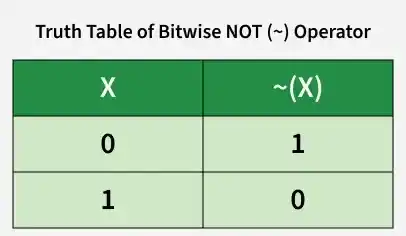
IV. Bitwise NOT Operator ( ~ ) Flips all the bits of a number, converting 1s to 0s and 0s to 1s. It is useful when we need the complement of a number or while clearing bits using masks. 👁 truth_table_of_bitwise_not_operator Example - ~5 → ~ (00...00101) 2 → (11...11010) 2
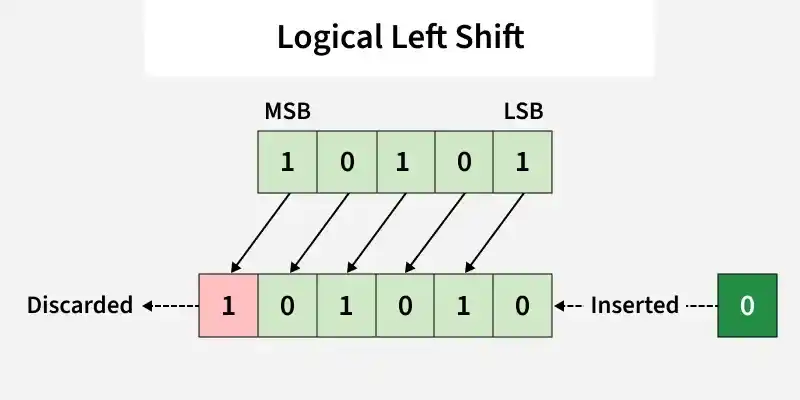
V. Left Shift Operator ( << ) Shift a bit to left , adds 0s to its right. Equivalent to multiply by 2 . It is often used for fast multiplication by powers of two. Example - (21 << 1)→ ( (10101) 2 << 1) → (01010) 2 → 10
👁 logical_left_shift
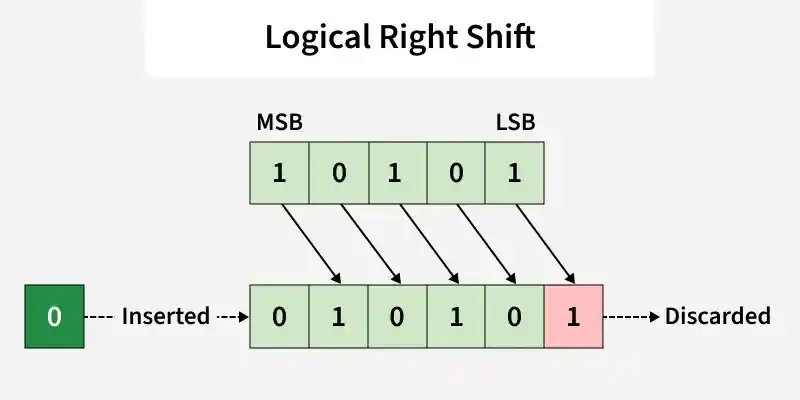
VI. Right Shift Operator ( >> ) Shift bits to the right . Equivalent to dividing by 2 . It is used for fast division by powers of two. Example - (21 >> 1)→ ( (10101) 2 >> 1) → (01010) 2 → 10
👁 logical_right_shift Built-in Bit Functions : Basic Practice Problems on Bitwise Algorithm : Note: All the Bitwise Practice Problems are optimized and run in O(1) Time Complexity with O(1) Auxiliary Space.
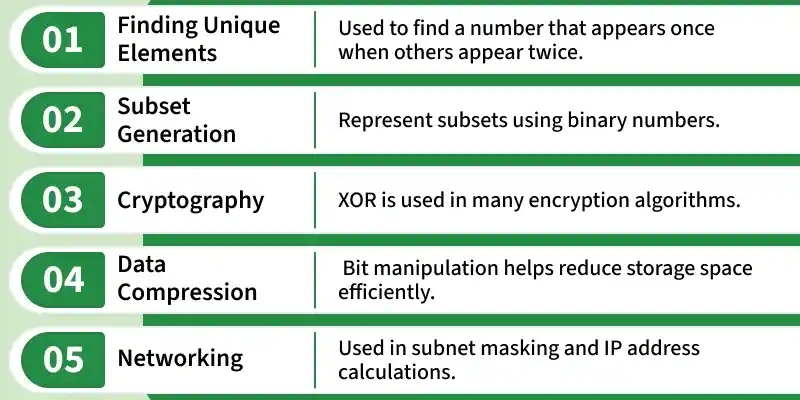
I. Set the i-th Bit in an Integer First, we left shift 1 to i-th position via ( 1<<n ). Then, use the "OR" operator to set the bit at that position. II. Unset/Clear the i-th Bit in an Integer Left shift 1 by n positions using (1 << n) to create a mask with a 1 at the i-th bit. Apply bitwise NOT ( ~ ) to the mask to make the nth bit 0 and all other bits 1. Perform bitwise AND num & mask. Since AND with 0 clears the bit and AND with 1 keeps it unchanged, the nth bit of num gets unset (cleared). III. Toggling the i-th Bit of an Integer Left shift 1 by n positions using (1 << n) to create a mask with a 1 at the i-th bit. Then take the Xor ( ^) with of the mask with the number. IV. Count Set Bits in an Integer You can use a built-in function or iterate through a loop to count the number of bits. V. Check if a Number is Power of 2 or Not If N is a power of 2, then N & (N−1) =0 This condition is also true for N=0. Final check: n && !( n & ( n-1 )); Application of Bit Manipulation : 👁 finding_unique_elements