|
VOOZH | about |
|
VOOZH | about |
Given an integer array arr[] sorted in ascending order, along with three integers: A, B, and C. The task is to transform each element x in the array using the quadratic function A*(x^2) + B*x + C. After applying this transformation to every element, return the modified array in sorted order.
Examples:
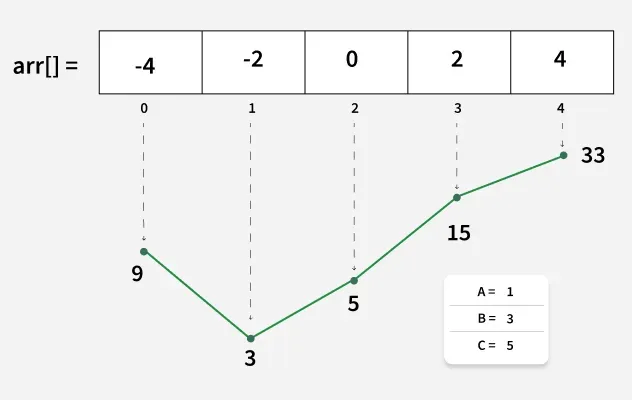
Input: arr[] = [-4, -2, 0, 2, 4], A = 1, B = 3, C = 5
Output: [3, 5, 9, 15, 33]
Explanation: After applying f(x) = 1*x2+ 3*x + 5 to each x, we get [9, 3, 5, 15, 33]. After sorting this array, the array becomes [3, 5, 9, 15, 33].Input: arr[] = [-3, -1, 2, 4], A = -1, B = 0, C = 0
Output: [-16, -9, -4, -1]
Explanation: After applying f(x) = -1*x2 to each x, we get [-9, -1, -4, -16 ]. After sorting this array, the array becomes [-16, -9, -4, -1].Input: arr[] = [-1, 0, 1, 2, 3, 4], A = -1, B = 2, C = -1
Output: [-9, -4, -4, -1, -1, 0]
Table of Content
The idea is to directly transform each element in the array, i.e. for each element x in arr[], apply the given equation A*x2 + B*x + C in-place and then simply sort the array in ascending order.
3 5 9 15 33
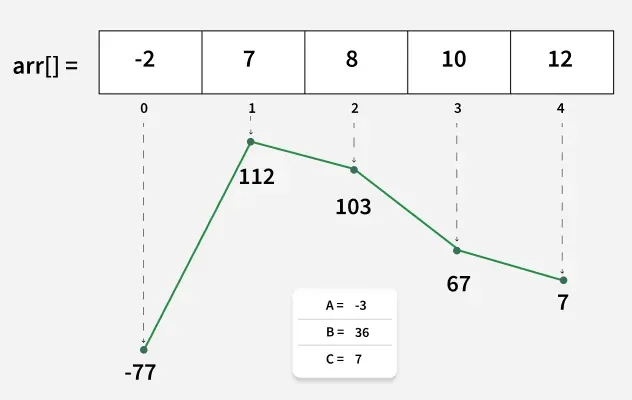
The idea is to use the fact that input array is sorted and apply a Two-Pointer approach. After applying the quadratic transformation to each element, the smallest and largest values will always be at the ends of the array (Why? The equation given is parabolic. So the result of applying it to a sorted array will result in an array that will have a maximum/minimum with the sub-arrays to its left and right sorted)
We process from both ends using two pointers (left and right) moving towards each other. By comparing the transformed values of arr[left] and arr[right], we can fill a new array (newArr) starting either from the front or the back depending on whether the coefficient A is positive or negative. The observation here is:
- if A >= 0, the largest values will be at the end
- while if A < 0, the largest values will be at the beginning.
There are two distinct cases when working with a quadratic transformation of a sorted array, and the nature of the function depends on the coefficient A.
Case 2: A < 0 – Concave parabola (opens downwards) → Has a peak (maximum point)
Step-by-Step Implementation:
Illustration:
3 5 9 15 33