|
VOOZH | about |
|
VOOZH | about |
A matrix is a two-dimensional data object made of m rows and n columns, therefore having total m x n values. If most of the elements of the matrix have 0 value, then it is called a sparse matrix.
Why to use Sparse Matrix instead of simple matrix ?
Example:
0 0 3 0 4
0 0 5 7 0
0 0 0 0 0
0 2 6 0 0
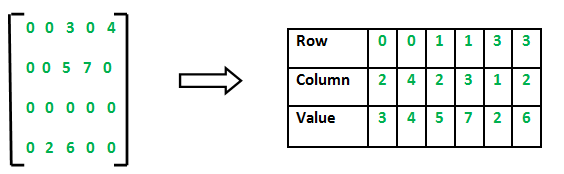
Representing a sparse matrix by a 2D array leads to wastage of lots of memory as zeroes in the matrix are of no use in most of the cases. So, instead of storing zeroes with non-zero elements, we only store non-zero elements. This means storing non-zero elements with triples- (Row, Column, value).
Sparse Matrix Representations can be done in many ways following are two common representations:
Method 1: Using Arrays:
2D array is used to represent a sparse matrix in which there are three rows named as
👁 Sparse Matrix Array Representation
Implementation:
 0 0 1 1 3 3
 2 4 2 3 1 2
 3 4 5 7 2 6
Time Complexity: O(NM), where N is the number of rows in the sparse matrix, and M is the number of columns in the sparse matrix.
Auxiliary Space: O(NM), where N is the number of rows in the sparse matrix, and M is the number of columns in the sparse matrix.
Method 2: Using Linked Lists
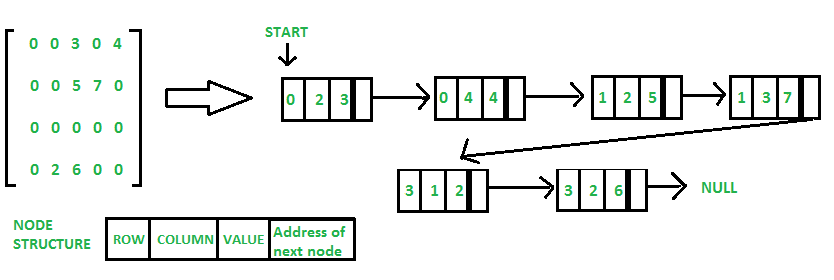
In linked list, each node has four fields. These four fields are defined as:
row_position:0 0 1 1 3 3
column_position:2 4 2 3 1 2
Value:3 4 5 7 2 6
Time Complexity: O(N*M), where N is the number of rows in the sparse matrix, and M is the number of columns in the sparse matrix.
Auxiliary Space: O(K), where K is the number of non-zero elements in the array.
Other representations:
As a Dictionary where row and column numbers are used as keys and values are matrix entries. This method saves space but sequential access of items is costly.
As a list of list. The idea is to make a list of rows and every item of list contains values. We can keep list items sorted by column numbers.
Sparse Matrix and its representations | Set 2 (Using List of Lists and Dictionary of keys)