|
VOOZH | about |
|
VOOZH | about |
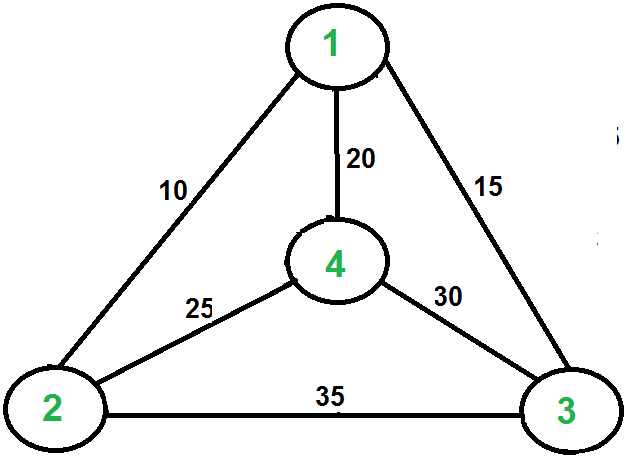
Given a 2D matrix tsp[][], where each row has the array of distances from that indexed city to all the other cities and -1 denotes that there doesn't exist a path between those two indexed cities. The task is to print minimum cost in TSP cycle.
Examples:
Input:
tsp[][] = {{-1, 10, 15, 20},
{10, -1, 35, 25},
{15, 35, -1, 30},
{20, 25, 30, -1}};
Below is the given graph:
Output: 80
Explanation:
We are trying to find out the path/route with the minimum cost such that our aim of visiting all cities once and return back to the source city is achieved. The path through which we can achieve that, can be represented as 1 -> 2 -> 4 -> 3 -> 1. Here, we started from city 1 and ended on the same visiting all other cities once on our way. The cost of our path/route is calculated as follows:
1 -> 2 = 10
2 -> 4 = 25
4 -> 3 = 30
3 -> 1 = 15
(All the costs are taken from the given 2D Array)
Hence, total cost = 10 + 25 + 30 + 15 = 80
Input:
tsp[][] = {{-1, 30, 25, 10},
{15, -1, 20, 40},
{10, 20, -1, 25},
{30, 10, 20, -1}};
Output: 50
We introduced Travelling Salesman Problem and discussed Naive and Dynamic Programming Solutions for the problem in the previous post. Both of the solutions are infeasible. In fact, there is no polynomial-time solution available for this problem as the problem is a known NP-Hard problem. There are approximate algorithms to solve the problem though.
This problem can be related to the Hamiltonian Cycle problem, in a way that here we know a Hamiltonian cycle exists in the graph, but our job is to find the cycle with minimum cost. Also, in a particular TSP graph, there can be many hamiltonian cycles but we need to output only one that satisfies our required aim of the problem.
Approach: This problem can be solved using Greedy Technique. Below are the steps:
Below is the implementation of the above approach:
Minimum Cost is : 80
Time Complexity: O(N2*log2N)
Auxiliary Space: O(N)