|
VOOZH | about |
|
VOOZH | about |
In programming, we often need a named storage location to store the data or values. Using variables, we can store the data in our program and access it afterward. In this article, we will learn about variables in programming, their types, declarations, initialization, naming conventions, etc.
Table of Content
Variable in Programming is a named storage location that holds a value or data. These values can change during the execution of a program, hence the term "variable." Variables are essential for storing and manipulating data in computer programs. A variable is the basic building block of a program that can be used in expressions as a substitute in place of the value it stores.
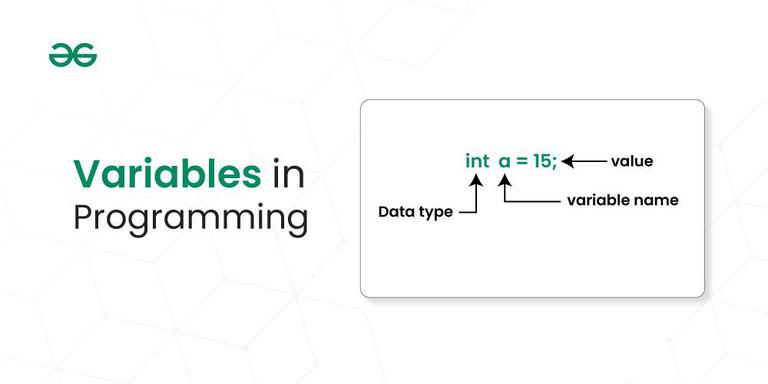
In programming, the declaration of variables involves specifying the type and name of a variable before it is used in the program. The syntax can vary slightly between programming languages, but the fundamental concept remains consistent.
Initialization of variables In Programming involves assigning an initial value to a declared variable. The syntax for variable initialization varies across programming languages.
Global variables in programming are declared outside any function or block in a program and accessible throughout the entire codebase. In simpler words, Global variables can be accessed in any part of the program, including functions, blocks, or modules.
5
5
Local variables in programming are declared within a specific function, block, or scope and are only accessible within that limited context. In simpler words, Local variables are confined to the block or function where they are declared and cannot be directly accessed outside that scope.
5
10
15
| Characteristic | Variable | Constant |
|---|---|---|
| Definition | A variable is a symbol that represents a value that can change during program execution. | A constant is a symbol that represents a fixed, unchanging value. |
| Mutability | Can be changed or reassigned during the execution of the program. | Cannot be changed once assigned a value. |
| Declaration and Initialization | Must be declared before use, and its value can be initialized at declaration or later in the code. | Must be assigned a value at the time of declaration, and its value cannot be changed afterward. |
| Examples | int count = 5; | const double PI = 3.14159; |
| Use Cases | Used for storing values that may vary or change during program execution. | Used for storing fixed values or parameters that should not be modified. |
| Memory Allocation | Allocates memory space to store the value. | Allocates memory space to store the value, similar to variables. |
| Syntax | dataType variableName = value; | const dataType constantName = value; |
| Characteristic | Global Variables | Local Variables |
|---|---|---|
| Scope1 | Accessible throughout the entire codebase | Confined to the block, function, or scope of declaration. |
| Visibility | Accessible by any part of the program, including functions, blocks, or modules | Accessible only within the limited context of declaration. |
| Lifetime | Exist for the entire duration of the program | It exists only during the execution of the block or function. |
| Initialization | May have a default value, can be initialized outside functions or blocks | May not have a default value, and must be explicitly initialized within the scope. |
| Access from Functions | Accessible directly from any function or block | Directly accessible only within the declaring function |
Naming conventions for variables In Programming help maintain code readability and consistency across programming projects. While specific conventions can vary between programming languages, some common practices are widely followed. Here are general guidelines for naming variables:
The scope of a variable in programming refers to the region of the program where the variable can be accessed or modified. It defines the visibility and lifetime of a variable within a program. There are typically two types of variable scope:
Inside myFunction: 10
Inside main: 20
Inside myFunction: 20
Understanding and managing variable scope is crucial for writing maintainable and bug-free code, as it helps avoid naming conflicts and unintended side effects.
In conclusion, variables In programming are fundamental elements in programming, serving as named storage locations to hold and manipulate data. They are crucial in writing dynamic, adaptable, and functional code. The proper use of variables, adherence to clear naming conventions, and understanding of scope contribute to code readability, maintainability, and scalability.