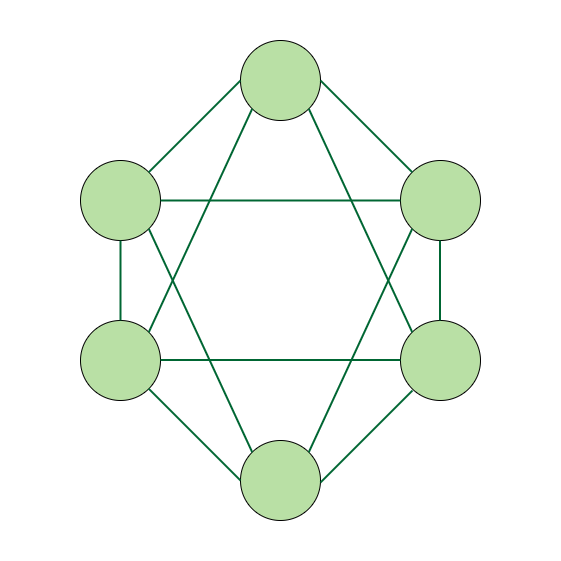
A k-connected graph is a type of graph where removing k-1 vertices (and edges) from the graph does not disconnect it.
In other words, there are at least k distinct paths between any two vertices in the graph, and the graph remains connected even if k-1 vertices or edges are removed.
The parameter k is known as the connectivity of the graph. The higher the connectivity of a graph, the more robust it is against failures or attacks.
Robustness: A k-connected graph is more robust against vertex or edge failures than a graph with lower connectivity. Removing k-1 vertices or edges from a k-connected graph does not disconnect it.
Minimum degree: In a k-connected graph, every vertex has a degree of at least k. This means that the graph is densely connected and has many paths between its vertices.
Separability: A graph is k-connected if and only if it is not separable into two disconnected subgraphs by removing k-1 vertices.
Augmentation: Every k-connected graph can be augmented to a (k+1)-connected graph by adding edges between any two sets of k vertices that are not already connected.
Planarity: In a planar k-connected graph, the number of vertices is at least 2k, and the number of edges is at least 3k - 6.
How to identify a k-connected Graph?
Brute force approach: One way to identify if a graph is k-connected is to remove all possible subsets of k-1 vertices (or edges) and check if the graph remains connected after each removal. This approach is not efficient for large graphs, but it can be used for small graphs.
Max-flow min-cut theorem: According to the Max-flow min-cut theorem, the maximum flow in a graph is equal to the minimum cut in the graph. Therefore, we can use a max-flow algorithm to find the minimum cut of a graph, and if the minimum cut is greater than or equal to k, then the graph is k-connected.
Connectivity algorithm: We can use a connectivity algorithm such as Tarjan's algorithm or Hopcroft–Karp algorithm to find all the cut-vertices and cut-edges in a graph. If there are no cut-vertices and cut-edges of size less than k-1, then the graph is k-connected.
DFS Algorithm: To check whether a graph is K-connected using DFS, first ensure that K is less than the total number of vertices n, since a graph cannot be K-connected if K≥n. Then, consider all possible ways of removing K−1 vertices from the graph. For each such removal, perform a DFS traversal on the remaining graph while ignoring the removed vertices. After the traversal, verify whether all the remaining vertices are still reachable, i.e., the graph remains connected. If the graph becomes disconnected for any removal, it is not K-connected. If it remains connected for all possible removals, then the graph is K-connected.