|
VOOZH | about |
|
VOOZH | about |
A Revenue Model is a strategic framework that explains how a business generates income from its products or services. It outlines pricing strategies, sales approaches, and customer engagement methods to ensure sustainable revenue growth. A strong revenue model not only identifies sources of income but also helps anticipate costs, optimize resource allocation, and support both short-term and long-term financial planning.
A well-defined revenue model is essential for the success and sustainability of a business. Its importance can be summarized as:
Financial Planning: Enables accurate budgeting and forecasting by anticipating income sources, estimating expenses, and defining financial goals.
Profitability Analysis: Helps assess income and costs across product lines, customer segments, or regions to understand profitability.
Resource Allocation: Guides optimal distribution of resources to the most revenue-generating areas.
Customer Value Proposition: Aligns pricing with the value perceived by customers, ensuring fairness and appeal.
Risk Management: Diversifies revenue streams to reduce dependency on a single source and maintain financial stability.
Better Decision-Making: Provides insights for strategic decisions in product development, marketing, and resource allocation based on revenue impact.
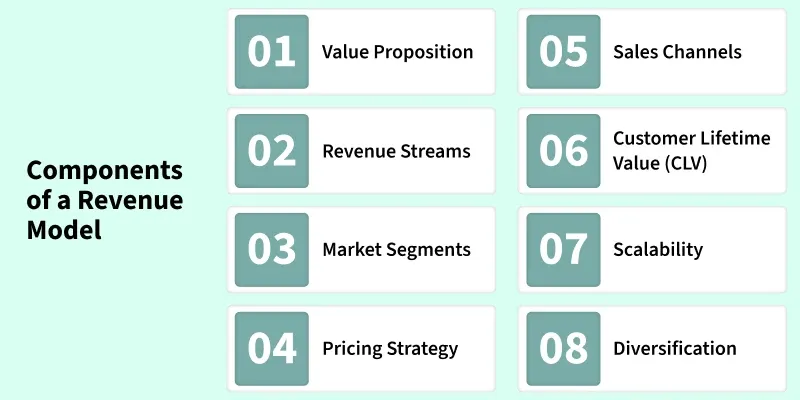
While components may vary depending on the business, industry, and target market, common elements include:
Businesses use different revenue models to generate income. Common types include:
1. Product Sales: Revenue from selling physical or digital products through one-time transactions.
2. Subscription Model: Recurring fees (monthly/annually) for access to a product or service, common in SaaS and media.
3. Advertising Model: Revenue from selling ad space on platforms, websites, or social media.
4. Freemium Model: Basic product/service offered for free; users pay for premium features.
5. Licensing Model: Revenue from licensing intellectual property like patents, trademarks, or software.
6. Transaction Fee Model: Platforms charge fees for facilitating transactions between buyers and sellers.
7. Affiliate Marketing Model: Earning commissions by promoting other companies’ products or services.
8. Crowdfunding Model: Raising funds via pledges from supporters, often with rewards or early access.
9. B2B Subscription Model: Recurring fees for business-to-business services supporting operations.
10. Agency Model: Earning commissions by acting as an intermediary between buyers and sellers.
11. Data Monetization Model: Generating revenue by selling aggregated/anonymized data for analytics or research.
12. Franchise Model: Granting rights to operate under a brand in exchange for fees and royalties.
A well-structured revenue model provides strategic advantages for sustained business growth:
Selecting the right revenue model is critical, as it impacts profitability, growth, and sustainability. Consider the following factors:
A well-defined revenue model is key to business success and sustainability. Follow these steps to craft an effective revenue model:
Symmetric and asymmetric revenue models refer to the balance or imbalance in value exchange between two parties involved in a business transaction. The following table gives a detailed view of these models,
Basis | Symmetric Revenue Models | Asymmetric Revenue Models |
|---|---|---|
| Definition | In a symmetric revenue model, the value exchanged between the platform (facilitator) and its users (buyers and sellers) is balanced. The platform charges both parties involved in a transaction an equal or proportionate fee. | In an asymmetric revenue model, the platform charges different fees to different parties involved in a transaction. This could be based on factors such as user behavior, transaction volume, or the strategic importance of a particular user group. |
| Characteristics |
|
|
| Advantages |
|
|
| Challenges |
|
|
| Example | Consider a marketplace where buyers and sellers come together to transact. In a symmetric model, the platform charges a percentage fee on the transaction value to both the buyer and the seller. For instance, a 2% fee might be charged to both parties. | In a ride-sharing platform, an asymmetric revenue model might involve charging drivers a higher percentage fee on each trip compared to passengers. The platform recognizes that drivers are key contributors to the service and may, therefore, apply a different fee structure to each party. |
Basis | Revenue Models | Business Models |
|---|---|---|
| Definition | Describes how a business generates income and profits. | Encompasses the overall strategy for creating, delivering, and capturing value in a market. |
| Focus | Primarily focused on how money is earned. | Encompasses a broader perspective, including value creation, delivery, and capture mechanisms. |
| Scope | Narrower in scope, specifically addressing income generation. | Broader in scope, covering the entire business strategy and value proposition. |
| Components | Primarily includes elements related to pricing, revenue streams, and monetization strategies. | Includes revenue models but goes beyond to include customer segments, channels, key activities, resources, partnerships, cost structure, etc. |
| Purpose | Outlines the ways a company plans to make money. | Provides a comprehensive view of how the entire business operates and sustains itself in the market. |
| Flexibility | Can be relatively easier to change or adapt based on shifts in income strategies. | May require more extensive changes if alterations to core business components are necessary. |
| Strategic Overview | Provides a specific view of the money-making aspect of the business. | Offers a holistic perspective, integrating various elements that drive overall business success. |
| Implementation Level | More tactical and focused on immediate revenue generation. | Strategic and guides long-term decision-making, impacting the overall sustainability of the business. |
| Example | Subscription model, advertising model, and transaction fee model. | Direct sales, freemium model, marketplace model, franchise model. |