|
VOOZH | about |
|
VOOZH | about |
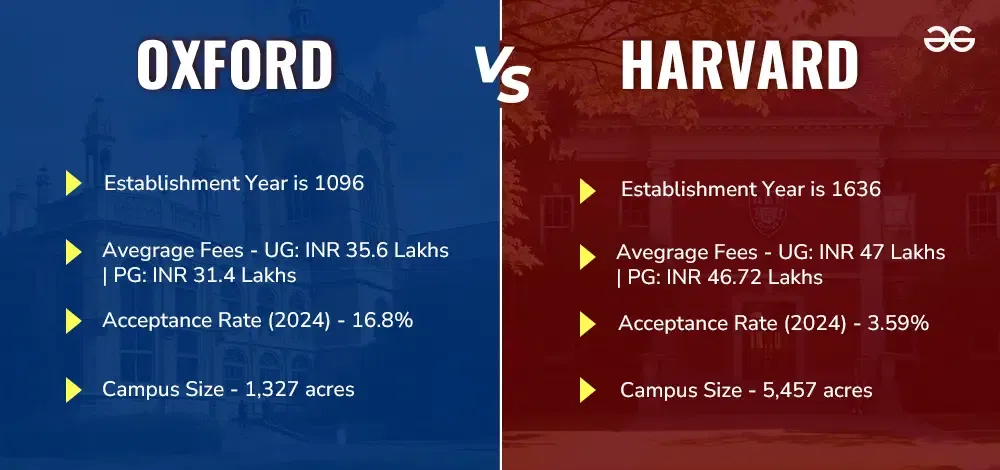
When you think of the top universities in the world, two obvious names stand out: Oxford and Harvard. Both prestigious universities rank among the top 5 in global university rankings. Oxford is the oldest university in the English-speaking world, having been established in 1096. Oxford is regularly ranked in the top five institutions in the world, and its alumni include more than 50 Nobel laureates.
In contrast, Harvard is the oldest university in the United States, having been founded in 1636. It has a global network of over 400,000 alumni, including eight presidents of the United States. With an endowment of USD 50 billion, the institution is a force for innovation.
They are both known for offering world-class education, research facilities, and access to renowned experts. We all know that Oxford and Harvard have produced countless renowned alumni in politics, royalty, science, business, and entertainment. While they share many similarities, several differences distinguish these two elite universities, making "Oxford vs Harvard University" a hard choice among prospective students.
In this article, we will compare Oxford and Harvard across various aspects to help you decide which might be the better fit for your academic journey.
Table of Content
Parameters | Oxford University | Harvard University |
|---|---|---|
Establishment Year | 1096 | 1636 |
World University Ranking 2024 | QS: #3 | THE: #1 | QS: #4 | THE: #4 |
Popular Courses | MBA, Architecture, Arts | MBA, Law, Medicine |
Average Fee (2024) | UG: INR 35.6 Lakhs | PG: INR 31.4 Lakhs | UG: INR 47 Lakhs | PG: INR 46.72 Lakhs |
Acceptance Rate (2024) | 16.8% | 3.59% |
Total Student Enrollment (2023) | 26,455 | 25,266 |
Campus Size | 1,327 acres | 5,457 acres |
Faculty Members | 14,841 | 19,639 |
Accommodation | Offered on-campus | Offered on-campus |
Scholarships | Offered | Need-based & Merit-based |
Placement Opportunities | Available | Available |
Total Alumni | 350,000+ | 400,000+ |
Rankings are an important factor when choosing a university. They show academic performance, research output, reputation, and other critical factors.
While both institutions consistently rank within the top 5 universities globally, Oxford is always the one to beat Harvard in recent rankings, especially in research and learning environment quality. However, rankings alone don’t provide the full picture, so let’s explore other areas.
Agencies | Oxford University | Harvard University |
|---|---|---|
THE - World University Rankings (2024) | #1 | #4 |
QS - World University Rankings (2024) | #3 | #4 |
US News & World Report - Global Rankings (2023) | #5 | #1 |
US News & World Report - National University Ranking (2023) | n/a | #1 |
The Guardian Ranking (2024) | #2 | ::n/a |
When considering the acceptance rates of top universities, it's important to note that both Harvard and Oxford are highly selective.
Admission Years | Harvard University | Oxford University |
|---|---|---|
2022-23 | 3.59% | 16.8% |
2021-22 | 3.4% | 14.5% |
2020-21 | 3.2% | 13% |
2019-20 | 3.4% | 14.1% |
2018-19 | 4.9% | 14.1% |
Both Harvard and Oxford attract students from across the globe, but their international student populations differ significantly.
Admissions requirements for both universities are rigorous but differ in their emphasis on certain qualifications.
Harvard and Oxford are excellent options for applying to the best colleges in the world; each has a different admissions procedure. Harvard's strict admissions requirements are reflected in its around 3% acceptance rate.
Oxford's overall admission rate, which is about 17%, highlights how difficult it is, particularly for popular courses. Prospective students hoping to get into these renowned academic settings must be aware of the particular entrance requirements of these elite universities.
Harvard University, as you are aware, only has a 3% success rate. This implies that it is crucial that you carefully submit your application.
The Harvard admissions standards are shown below.
Undergraduate Admissions
The prerequisites for Harvard University undergraduate courses are listed below.
Harvard University's graduate course entry requirements are as follows.
In the last five years, Oxford has seen a 22% increase in applications. One of the students who succeeds in getting into this university is you! See below for Oxford University's admission requirements.
Undergraduate Admissions
The prerequisites for Oxford University's undergraduate programs are listed below.
Graduate Admissions
The requirements for admission to Oxford University's graduate programs are as follows.
Did you know that the size of the global market for MBA education was estimated at USD 47.1 billion in 2022 and is expected to reach USD 83.08 billion by 2023–2032 at a compound annual growth rate (CAGR) of 15.6%? The Harvard MBA and the Oxford MBA are two of the most prominent programs for earning a Master of Business Administration (MBA).
Both programs have a stellar academic reputation.
| Program | Duration | Tuition Fees |
| Oxford MBA (Saïd Business School) | 1 year | INR 71.8L (GBP 67K) (total) |
| Harvard MBA (Harvard Business School) | 2 years | INR 63.6L (USD 76K) yearly |
Saïd Business School is a one-year, rigorous program that covers key topics like accounting, finance, entrepreneurship, marketing, strategy, and technology management. The Financial Times (2024) ranked it second in the UK and ninth in Europe.
Additionally, you have the option to select electives and take the Global Opportunities and Threats Oxford (GOTO) course, which focuses on global issues.
Harvard Business School is ranked sixth by US News & World Report's Best Business Schools 2024 and eleventh globally by the Financial Times (2024).
The two-year Harvard MBA program focuses on general management and leadership.
Foundational courses in operations, marketing, finance, and leadership are covered in the first year.
Field-based learning and a variety of electives are available in the second year.
The return on investment (ROI) of your degree depends on the costs incurred during your studies and the potential salary after graduation. Let’s look at the figures.
The average salary of a Harvard graduate is around USD 81,500 (INR 68.28 Lakhs) per year, making it one of the most lucrative degrees globally. Oxford graduates, on the other hand, earn a slightly lower average salary of around £40,000 (INR 44.08 Lakhs) annually.
While Harvard leads in terms of salary prospects, Oxford’s lower tuition fees can make it a more cost-effective option. Both institutions offer excellent opportunities for career advancement, but the ultimate ROI will depend on the specific field of study and career path.
Acceptance Rate in OxfordStudents enrolled in both universities are eligible for placements. The MBA programs at Oxford and Harvard have the highest placement rates since they are the most popular. Let's examine the recent MBA placement experiences at these two universities:
Parameters | Harvard University | Oxford University |
|---|---|---|
Total Placements | 86% | 88% |
Average Salary | USD 120,000 (₹1 Cr) | £83,410 (₹87.42 Lakhs) |
Median Salary | USD 175,000 (₹1.45 Cr) | £28,000 (₹29.34 Lakhs) |
Top Industry for Placement | Finance: 33% | Consulting: 31.9% |
Highest Average Salary | Consulting: USD 190,000 (₹1.58 Cr) | Technology: £89,554 (₹93.86 Lakhs) |
Let’s now explore some critical factors to help answer whether Oxford is better than Harvard.
Global Recognition and Rankings
As mentioned, Oxford has been consistently ranked higher than Harvard in the QS and THE World University Rankings, especially in recent years. However, both universities enjoy unparalleled global recognition, and choosing one over the other won’t limit your future prospects.
Cost of Studying
When comparing costs, Oxford is significantly more affordable. The average tuition fee for international students at Oxford ranges from £27,840 to £39,010 (INR 30.68–43 Lakhs) per annum. Harvard’s tuition fee for international students, by comparison, is around USD 51,143 (INR 42.84 Lakhs) per annum.
Return on Investment
While Harvard graduates typically earn higher salaries, Oxford graduates also do well, especially considering the lower tuition fees. The cost-benefit balance leans towards Oxford for students looking for quality education at a lower cost.
Score Requirements
Oxford’s academic standards are slightly higher in terms of GPA and standardized test scores. Applicants need a GPA of 4.5, while Harvard may accept applications with a GPA of 4.0. However, Harvard places more emphasis on a student’s overall personality and achievements beyond academics.
Acceptance Rate
With an acceptance rate of 5%, Harvard is significantly more selective than Oxford, which has an acceptance rate of 17%. Applicants with outstanding academic records and extracurricular accomplishments may find Oxford more accessible.
Life and Culture
Both universities offer rich, diverse cultural experiences. Oxford, with its 42% international student population, has a more globally diverse community compared to Harvard, where 22% of students are from outside the U.S.
Oxford also boasts over 400 student clubs catering to various political, cultural, and academic interests. Harvard provides numerous extracurricular opportunities, including 42 intercollegiate sports teams in the NCAA Division I Ivy League.
Similar Reads: