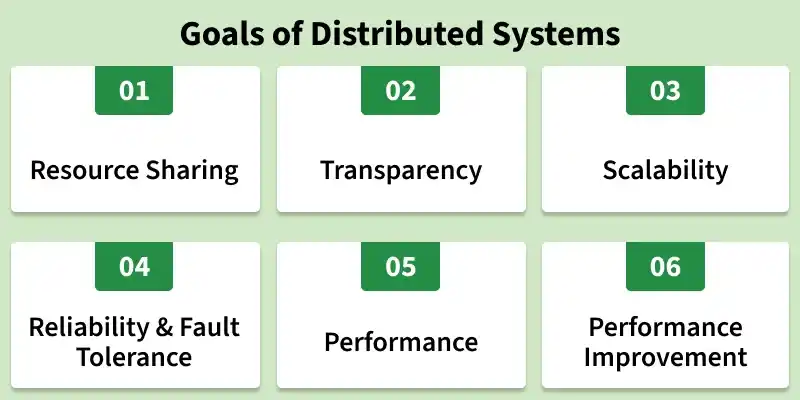
The goals of a Distributed System define the key objectives that guide the design and operation of multiple interconnected computers working as a unified system.
Enable efficient resource sharing across distributed nodes. Provide transparency by hiding distribution complexity. 👁 core_goals_of_distributed_systems Goals of Distributed Systems 1. Resource Sharing It is a core goal of distributed systems that allows multiple computers to access and use hardware, software, and data resources.
Supports collaborative work and data consistency across systems. Distributes workload efficiently among multiple machines. Reduce redundancy and improve overall resource utilizatioin. 2. Transparency This hides the complexity of multiple interconnected components and presents the system as a single platform to users.
Manages replication without exposing multiple data copies to users. Masks certain failures to maintain smooth system operation. Improves usability by providing abstraction and simplifying interaction. 3. Scalability It handles increasing users, data, and workload in the system.
Supports growth in users, transactions, and data volume efficiently. Enables horizontal scaling by adding more machines to distribute load. Supports vertical scaling by upgrading hardware resources of existing machines. 4. Reliability and Fault Tolerance This ensure that system will operate perfectly and consistenely even when some components fails.
Recovers automatically using backup nodes or failover strategies. To prevent single point failures it uses redundancy and replication. Provides data intergrity and consistent service availability. 5. Security It provides securtiy to data, resources andcommunication across the different connected nodes.
Ensures authentication to verify the identity of users and systems. Protects confidentiality through encryption and secure storage. Uses secure communication protocols to safeguard data during transmission. 6. Performance Improvement It focuses on increasing system speed, responsiveness, and overall efficiency.
Reduces latency by processing requests closer to users. Increases throughput by handling multiple request at a time. For faster response time it optimize resource utilization. 7. Openness T his operates using standard protocols and publicly defined interfaces, allowing seamless integration of components.
Uses standard communication protocols and APIs for system interaction. Supports interoperability between heterogeneous systems and platforms. Allows integration of third-party services and components. 8. Heterogeneity Allows programs to operates in different hardware platforms, operating systems, network types and programming environments.
Uses middleware and standard protocols to manage diversity efficiently. Allows cross-platform integration of services and applications. Allow continious communication despite of different technologies. 9. Concurrency It manages different processes and users accessing shared resoures at the same time while maintaing correctness and consistency.
Improves system efficiency and overall throughput. To prevent data conflicts it uses synchronization mechanisms. Uses coordination protocols to maintain consistency.