gRPC (Google Remote Procedure Call) is an open-source RPC framework designed to enable efficient communication between client and server applications.
Developed by Google and later released as an open-source project.
Provides a structured approach for invoking remote methods.
Focuses on performance, reliability, and interoperability.
Purpose and Core Features of gRPC
Uses HTTP/2 as its base transport protocol.
For fast and compact binary data serialisation, it uses protocol buffers.
Supports multiple programming languages, allowing cross-language service interaction.
Provides strongly typed service contracts through .proto files.
Supports multiple communication patterns, including unary and streaming RPCs.
gRPC Architecture
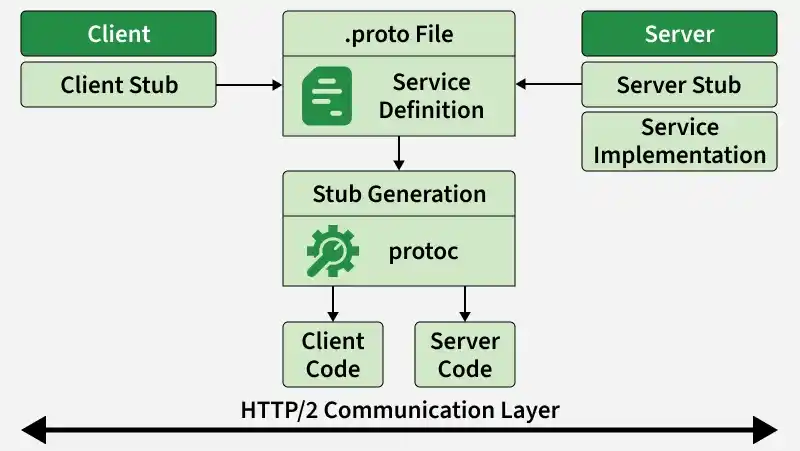
This follows a client-server model in which Protocol Buffer defines services and communication happens over HTTP/2 with automatically generated code stubs.
Client: The client application invokes remote methods as if they were local function calls using a generated client stub.
Server: The server implements the service methods defined in the .proto file and processes incoming RPC requests.
Service Definition (.proto file): Services in gRPC are defined using Protocol Buffers (protobuf), which specify the available methods and their input/output message types. For example:
Stub Generation: The protoc The compiler generates client and server stubs in the target programming language based on the .proto definition.
HTTP/2 Communication Layer: All RPC calls are transmitted over HTTP/2, enabling multiplexing, efficient binary framing, and persistent connections
Defining Services Using Protocol Buffers
In gRPC, services and data structures are defined using Protocol Buffers (Protobuf), a language-neutral and platform-neutral interface definition language that specifies how clients and servers communicate.
A .proto The file contains the service definitions and message structures that act as a formal contract between client and server.
A service definition declares RPC methods, including the request and response message types for each remote call.
A message definition specifies the structure of the data being transmitted, including fields and their data types.
Each field in a message is assigned a unique number, which is used internally for binary serialisation and must not be reused after removal.
The pprotocol compiler generates client and server code (stubs) in the desired programming language based on the .proto file.
Setting Up a gRPC Environment
To set up a gRPC environment, follow these steps:
Install gRPC Libraries: Use package managers like npm for Node.js, pip for Python, or Maven for Java to install gRPC libraries.
Define the Service: Create a .proto file that defines the service and its methods. For example:
Generate Code: Use the Protocol Buffers compiler (protoc) to generate client and server code from the .proto file.
Implement Server and Client: Implement the server logic by defining the methods and starting the gRPC server. Implement the client to call the server methods.
Run the Server and Client: Start the server and run the client to test communication.
Communication Patterns in gRPC
1. Unary RPC
It is the simplest communication pattern where the client sends a single request and receives a single response from the server.
The client sends one complete request message.
The connection is closed after the response is delivered.
It is similar to a traditional function call.
It is commonly used in standard API operations.
2. Server Streaming RPC
Allows the client to send one request and receive multiple response messages from the server.
The client sends a single request message.
The server sends a stream of responses over time.
It is useful for large datasets or continuous updates.
The client reads responses sequentially from the stream.
3. Client Streaming RPC
Allows the client to send multiple request messages to the server before receiving a single response.
The client sends a sequence of request messages.
The server processes all received messages collectively.
The server returns one final response after processing.
It is useful for uploading large amounts of data in parts.
4. Bidirectional Streaming RPC
Allows both client and server to send multiple messages to each other independently over a single connection.
Messages can be sent and received simultaneously.
The order of messages is preserved within each stream.
It supports real-time interactive communication.
It is useful for chat applications and live data feeds
Error Handling in gRPC
Error Handling ensures that communication failures, invalid requests, and service issues are properly detected, reported, and managed between client and server.
1. Status Codes
gRPC uses standardised status codes to indicate the result of an RPC call.
Each RPC call returns a status code along with the response.
Codes such as OK, NOT_FOUND, INVALID_ARGUMENT, and UNAVAILABLE describe specific outcomes.
Status codes help clients understand the exact reason for failure.
2. Error Details
Provide additional structured information about a failure beyond the basic status code.
They allow servers to attach descriptive error messages.
Structured metadata can be included for debugging purposes.
Clients can programmatically interpret detailed error information.
3. Deadlines and Timeouts
The maximum time a client is willing to wait for a response from the server.
The client specifies a deadline for completing the RPC call.
If the deadline is exceeded, the call is automatically terminated.
It helps maintain system responsiveness and resource control.
4. Retry Mechanisms
Allow a client to automatically attempt a failed RPC call under specific conditions.
Retries are typically used for transient failures such as temporary network issues.
Policies can define the number of retry attempts and delay intervals.
Retries should be carefully configured to avoid overloading the server.
Security in gRPC
1. TLS Encryption
It protects communication from interception and tampering.
Digital certificates are used to verify server identity.
TLS is recommended for production environments.
2. Authentication Mechanisms
Mutual TLS (mTLS) allows both client and server verification.
Credentials can be attached to each RPC request.
Authentication restricts access to authorised users only.
3. Metadata Handling
It is commonly used to send authentication tokens.
Custom headers can be included for access control.